
Prepartory documents for CEO appearance before House of Commons Natural Resources Committee February 12 2026
Topic: “Subject Matter of Clauses 593 and 594 (Division 41) of Bill C-15, An Act to Implement Certain Provisions of the Budget Tabled in Parliament on November 4, 2025”
Table of Contents
- OPENING REMARKS (Bilingual)
- COMMITTEE PROFILE
- SCENARIO NOTE
- POTENTIAL QUESTIONS AND ANSWERS
- KEY BRIEFINGS
- A) CER Regulatory Requirements and Timing Statistics
- B) Legislative/Drafting Context
- C) Recent Application Fact Sheets, including LNG Canada, Cedar LNG and Kitsault Energy
- D) Regulatory Information
- E) Summary of Previous CER Senate Appearance on the proposed change to the CER Act
- F) Summary of RNNR Meeting on Canadian Energy Exports, Feb 3
- G) Summary of RNNR Meeting on Canadian Energy Exports, Feb 5
- H) Projects in the National Interest
- ENVIRONMENTAL SCAN
OPENING REMARKS (Bilingual)
Check against delivery / L’allocution fait foi
INTRODUCTION
Good afternoon, Members of Parliament. Thank you for inviting the Canada Energy Regulator (or CER for short) to appear as part of your study of Bill C-15 and specifically the proposed change to the Canadian Energy Regulator Act that is included in Section 5, Division 41.
My name is Tracy Sletto, and I am the Chief Executive Officer at the CER.
I am joined today by Darren Christie, our Chief Economist, and Jonathan Timlin, our Vice-President, Systems Operations.
In my opening remarks, I’ll briefly describe the CER’s mandate and discuss how we regulate natural gas exports. I will also touch on how the proposed change to our Act, which would increase the maximum duration of export licences for liquified natural gas from 40 to 50 years, could impact our regulatory responsibilities.
LAND ACKNOWLEDGEMENT
But before going further, I would like to acknowledge that I am on the unceded, ancestral, and traditional territory of the Algonquin Anishinaabe [Ah-nish-naw-bae] Nation, who have lived on and cared for the land now known as Ottawa since time immemorial.
CER MANDATE
The CER’s mandate is clear. We regulate energy infrastructure – specifically international and interprovincial pipelines, international powerlines, and offshore energy projects and powerlines – in a way that prevents harm and ensures the safe, reliable, competitive and environmentally sustainable delivery of energy to Canada and the world.
The CER is also responsible for advising and reporting on energy matters. One way we do this is through our Energy Futures series, where we explore how possible energy futures might unfold for Canadians over the long term. In addition to the Energy Futures reports, the CER develops Provincial-Territorial energy profiles, produces market-snapshots that highlight key trends in Canada’s energy sector, and publishes oil and gas production statistics.
EXPORT ADJUDICATION
The CER’s mandate also includes the regulation of hydrocarbon and electricity exports from Canada. Our role in regulating these exports, including for natural gas, is set by the CER Act, specifically under Part 7 of the Act.
For the exportation of natural gas, the Commission of the CER currently has authority to issue licences for up to 40 years, subject to approval by the Minister of Energy & Natural Resources, and to issue short-term export orders for up to 2 years.
The maximum term for natural gas export licences was extended from 25 years to 40 years in 2015 through amendments to the National Energy Board Act. This change was carried forward under the CER Act in 2019. When assessing applications for long-term natural gas export licences, the Commission of the CER applies a “surplus test” that is set out in section 345 of the CER Act. This test establishes that the proposed exports must not exceed the amount of natural gas expected to be available after meeting the reasonably foreseeable needs of Canadians, taking into consideration the trends in the discovery of gas in Canada.
Applicants for natural gas export licenses must provide supply and demand projections and demonstrate that exports will not compromise Canada’s domestic energy requirements. The Commission of the CER reviews these applications through a written process, including a public comment period, and must decide within 180 days, followed by a Ministerial decision.
Currently, there are 24 valid export licences linked to LNG projects, with 18 of them for 25-year terms and 6 for 40-year terms. Companies apply for export licences in advance of construction and operation so even though there are 24 valid licences, only one is currently in use -- the 40-year export licence for LNG Canada, a natural gas liquefaction facility and marine terminal for exporting LNG in Kitimat, BC.
Other than the licence for LNG Canada, all of Canada’s natural gas currently being exported is under what are called export orders rather than export licences. These orders are generally for a maximum of two years and, given their technical and administrative nature, they typically receive CER Commission approval within two working days after being submitted through our online application system. The CER receives approximately 100 applications for these orders every year.
IMPACT TO OUR REGULATORY RESPONSIBILITIES
In terms of impacts for our regulatory responsibilities, this potential change to our Act would only apply to export licences for LNG, and not to the other exports we regulate such as oil or electricity.
The change proposed in Bill C-15 would not automatically extend the term for existing export licences. Companies with existing licences would have the option to reapply to the CER to receive a 50-year licence. This is similar to when the maximum term for natural gas licences was increased from 25 to 40 years.
CONCLUSION
In closing, I want to thank you for giving me the opportunity to speak with you today about the work of the CER. My colleagues and I look forward to your questions.
COMMITTEE PROFILE

Shannon Stubbs
Riding: Lakeland, AB
Political Party: Conservative
Profession: Public Servant, MLA
Elected to Parliament: October 2015
Shadow Minister for Natural Resources (Critic)
General Information:
Ms. Stubbs graduated with Honours/B.A. in Political Science and English from the University of Alberta. She interned in Ottawa for the Leader of the Official Opposition, Preston Manning, and worked in the constituency office of MP Deborah Grey. Ms. Stubbs worked in the field of public relations, where she advocated on behalf of not-for-profit organizations, charities, educational institutions, pharmaceutical companies, and the oil and gas sector. She worked in the Oil Sands Business Unit of the Alberta Ministry of Energy, and she eventually moved on to the International Offices and Trade Division of the Ministry of Economic Development. She provided policy development, research and communications support, led the organization of a series of public-private workshops on transportation infrastructure, labour needs, royalties and taxation, First Nations relations, and environmental stewardship in Alberta’s oil sands regions, and hydrocarbon upgrading development. Additionally, she co-led an international marketing and advocacy project for the oil sands and heavy oil technology, supply and services businesses.
She served as Danielle Smith's Chief of Staff from 2010–12 and the party's Director of Legislative Affairs from 2012–14. Ms. Stubbs has served as the federal MP for Lakehead since October 2015. She served as both the Shadow Minister and Deputy Critic for Natural Resources from 2015-19. Prior to her re-appointment to the Natural Resources critic role, she held the CPC critic roles for Rural Economic Development and Rural Broadband, and Public Safety and Emergency Preparedness. Ms. Stubbs has sat on numerous parliamentary committees and was the Vice Chair of the Standing Committees on Natural Resources, Public Safety and National Security, and the Special Select Standing Committee for Pay Equity.
Top Issues: regulatory efficiency, energy project approval, the oil and gas sector, LNG, energy affordability, energy security.
Items of Interest:
Order Paper Questions:
Q-110 — November 25, 2021 — With regard to the government’s decision to “set a national emission reduction target of 30% below 2020 levels from fertilizers,” as laid out in Environment and Climate Change’s 2020 plan entitled “A Healthy Environment and a Healthy Economy“: (a) what is the full list of “manufacturers, farmers, provinces and territories”, as defined by the “A Healthy Environment and a Healthy Economy“ plan, that were consulted about this decision prior to the release of the plan; (b) what are the details of all consultations which were held regarding the economic impact of this decision prior to the release of the plan, specifically on the agricultural sector and food production; and (c) what is the full list of “manufacturers, farmers, provinces and territories”, as defined by the “A Healthy Environment and a Healthy Economy“ plan, that have been consulted regarding the economic impact of this decision from December 2020 to the present?
Q-124 — November 29, 2021 — With regard to the government's decision to "set a national emission reduction target of 30% below 2020 levels from fertilizers," as laid out in Environment and Climate Change Canada's 2020 plan entitled "A Healthy Environment and a Healthy Economy": (a) has Farm Credit Canada done any analysis related to the impact that lower fertilizer amounts will have on crop production, and if so, what are the details, including findings of the analysis; (b) what is the projected increase in both demand and federal budget for business risk management (BRM) programs like AgriStability and AgriRecovery, as a result of this decision; (c) what new measures are proposed to adjust for the decline in crop yields, specifically pertaining to the historical reference period used for determining eligibility for BRM programs; (d) what new insurance programs or financial assistance programs will be available for farmers whose crop yields rely disproportionately on their ability to use fertilizer, and will be disproportionately affected by mandatory reductions in fertilizer use; (e) what are Farm Credit Canada's projections regarding yield gaps, broken down by each different type of Canadian crop, each year from now until 2030; and (f) has Health Canada or any other government department or agency done any analysis on the ability of Canadians to pay more for food at the grocery store as a result of lower yields by Canadian farmers, and if so, what are the details, including findings?
Q-984 — November 17, 2022 — With regard to proposals in Canada related to liquefied natural gas active since November 4, 2015, which were received or known by the government: (a) what are the details of all the proposals received or known by Natural Resources Canada (NRCan), including, for each, (i) the date the proposal was received by NRCan, (ii) the date NRCan was made aware of the proposal, (iii) the summary of the proposal, (iv) who made the proposal, (v) the decisions made by the government related to the proposal, including the date of each, (vi) the current status of the proposal, (vii) the expected date for a decision to be made, if applicable; and (b) what are the details of all proposals received or known by Environment and Climate Change Canada (ECCC), including, for each, (i) the date the proposal was received by ECCC, (ii) the date ECCC was made aware of the proposal, (iii) the summary of the proposal, (iv) who made the proposal, (v) the decisions made by the government related to the proposal, including the date of each, (vi) the current status of the proposal, (vii) the date by which a decision is expected to be made, if applicable?
Q-1050 — November 30, 2022 — With regard to the statement on Twitter by the Minister of Natural Resources on November 28, 2022, that “Climate change will cost Canadians $100 billion a year by 2050 - unless we hit our climate targets”: (a) what methodology was used by the minister to come up with that figure; and (b) what are the government’s projections on how much climate change will cost Canadians each year, by 2050, if the government does hit its climate targets?
Q-1132 — December 12, 2022 — With regard to the Trans Mountain Expansion Project of the Trans Mountain Corporation, a subsidiary of the Canada Development Investment Corporation, broken down by year from 2018 to present: what is the total amount spent, or allocated to be spent, on persons not employed by the Trans Mountain Corporation or the government engaging in (i) external communications, (ii) internal communications, (iii) liaison activities between any department or ministry of the government and Trans Mountain Corporation, (iv) image consulting or similar type of consulting?
Q-1133 — December 12, 2022 — With regard to statistics held by the government related to entities engaging in blending operations of renewable fuel and petroleum fuel in Canada: (a) what are the details of all known blending operations in Canada, including locations; (b) for each blending location, what are the countries of origin of the renewable feedstock; and (c) what percentage of renewable fuel used in Canadian blending operations originated from each country, broken down by year since 2015?
Q-1981 — November 16, 2023 — With regard to the government's promotion of heat pumps: (a) how many applications for funding through the Oil to Heat Pump Affordability Program have been received; (b) of the applications in (a), how many (i) were denied, (ii) were granted, (iii) are still awaiting a decision; (c) how many heat pumps have been installed through the granted applications in (b); (d) what is the breakdown of (a) through (c), by province or territory; (e) how many applications for funding for heat pumps have been received through the Canada Greener Homes Grant; (f) of the applications in (e), how many (i) were denied, (ii) were granted, (iii) are still awaiting a decision; (g) how many heat pumps have been installed through the granted applications in (f); and (h) what is the breakdown of (e) through (g), by province or territory?
Q-2038 — November 29, 2023 — With regard to the comments by the Prime Minister in the House of Commons on November 8, 2023, that "tens of thousands of people across the Prairies are getting the chance to replace their home heating oil": what is the breakdown of the number of homes on the Prairies that currently use home heating oil, broken down by each of the Prairie provinces?
Q-3116 — October 23, 2024 — Mrs. Stubbs (Lakeland) — With regard to the government's commitment to plant 2 billion trees by 2031: (a) what are the total expenditures to date in relation to the commitment; (b) how many trees have been planted to date; and (c) what is the projected number of trees to be planted under the commitment in (i) 2024, (ii) 2025, (iii) 2026, (iv) 2027, (v) 2028, (vi) 2029, (vii) 2030, (viii) 2031?
Private Members’ Bills and Motions
In the 43rd Parliament, Shannon Stubbs introduced C-221, the Environmental Restoration Incentive Act. This bill sought to establish a tax credit for the closure of oil and gas wells. The bill was defeated at Second Reading.

Corey Tochor
Riding: Saskatoon—University, SK
Political Party: Conservative
Profession: Entrepreneur, MLA
Elected to Parliament: October 2019
Associate Shadow Minister for Natural Resources (Nuclear)
General Information: Corey Tochor was elected as a Member of Parliament to represent the federal riding of Saskatoon-University on October 21, 2019. He was re-elected in September 2021 and May 2025. In the 44th Parliament, he served as the Vice-Chair on the Science and Research committee and is currently the Associate Shadow Minister for Natural Resources (Nuclear) for the Conservative Party.
Corey was born and raised in Esterhazy, Saskatchewan and prior to entering politics, was a local Saskatoon entrepreneur who owned and operated Health Conveyance, a communications company that provides electronic messaging in health facilities across the province. Corey graduated with a commerce degree from the U of S with a major in Finance. He had a successful career in sales, e-learning consulting and pharmaceuticals before starting his own business. These experiences have helped Corey become a strong voice for the local Saskatoon business community.
As an active volunteer in his local community, Corey served for many years on the executive of the Kinsmen Club of Saskatoon including on the corporate board for Telemiracle 33, chair of fundraising projects and treasurer of the Kinsmen Activity Place House, a community center supporting Saskatoon’s core.
Top Issues: Nuclear energy development and regulation including disposal, uranium development, climate change and cost of living, renewable energy and fuels development.
Items of Interest:
Order Paper Questions:
Q-153 — December 3, 2021 — Mr. Tochor (Saskatoon—University) — With regard to any contracts or businesses dealings between any government department, agency, Crown Corporation, or other government entity and Global Health Imports Corporation, since the company was incorporated in April 2020: (a) what are the details of any contracts with the company, including the (i) date, (ii) value of the contract, (iii) description of goods or services, including the volume, (iv) reason the contract is not listed through proactive disclosure, if applicable; and (b) what are the details of all submissions, proposals or inquiries received by the government from the company, including the (i) sender, (ii) recipient, (iii) date, (iv) title, (v) summary, (vi) summary of response?
Q-909 — October 21, 2022 — Mr. Tochor (Saskatoon-University) — With regard to government procurement and contracts for the provision of research or speechwriting services to ministers, since March 1, 2022: (a) what are the details of all contracts, including the (i) start and end dates, (ii) contracting parties, (iii) file number, (iv) nature or description of the work, (v) value of the contract; and (b) with regard to contracts for speechwriting, what is the (i) date, (ii) location, (iii) audience or event at which the speech was, or intended to be, delivered, (iv) number of speeches written, (v) cost charged per speech?
Q-2627 — April 30, 2024 — Mr. Tochor (Saskatoon—University) — With regard to sole-sourced contracts entered into by the government related to products or services for ministers or their offices, including the Office of the Prime Minister, since January 1, 2019, broken down by each minister: what are the details of each such contract, including, for each, the (i) date, (ii) vendor, (iii) amount, (iv) description of goods or services?
Private Members’ Bills and Motions
In the 44th Parliament, Corey Tochor introduced C-380, An Act to amend the Canadian Environmental Protection Act, 1999 (plastic manufactured items), which sought to amend the Canadian Environmental Protection Act, 1999 to delete plastic manufactured items from the list of toxic substances in Schedule 1. The bill was defeated at second reading.

Richard Martel
Riding: Chicoutimi—Le Fjord, QC
Political Party: Conservative
Profession: Hockey Coach
Elected to Parliament: June 2018
General Information:
Richard Martel was born in Chicoutimi, QC. He was a successful hockey coach for 21 years in the Quebec Major Junior Hockey League before being elected to the House of Commons in a byelection in 2018. In Parliament, he was the CPC’s associate critic on National Defence, and was named the party’s Quebec lieutenant under the leadership of Erin O’Toole. However, after the CPC failed to make gains in Quebec during the 2021 federal election he lost the Quebec lieutenant role to Alain Rayes.
Top Issues: LNG, Forestry, Critical Minerals.
Items of Interest:
Order Paper Questions:
N/A
Private Members’ Bills and Motions
N/A

Gaétan Malette
Riding: Kapuskasing—Timmins—Mushkegowuk, ON
Political Party: Conservative
Profession: Retired Forestry Executive
Elected to Parliament: April 2025
Associate Shadow Minister for Natural Resources (Mining & Forestry)
General Information:
Gaétan Malette was born and raised in Timmins and is a retired forestry executive. He's also had leadership roles on several boards, including as Commissioner of Ontario Northland, an Ontario Crown agency and an economic development engine for Northern Ontario, as well as the Timmins and District Hospital, the francophone health centre, and the Timmins Police Services Board. In addition, he has served as Director of the Canadian Lumber Manufacturers Association, and as a board member of the Nawiinginokiima Forest Management Corporation, a Crown Agency that promotes partnerships between First Nations and communities in Ontario around forest management issues. Mr. Malette was also previously an employee of Domtar from 1998 to 2007. Of note, Domtar was acquired by Asian conglomerate Paper Excellence in 2021.
In the 2025 Ontario provincial election, he was the campaign chair for now MPP and Minister of Mines George Pirie's successful bid.
Top Issues: Forestry, Mining.
Items of Interest:
Order Paper Questions:
N/A
Private Members’ Bills and Motions
N/A

Mario Simard
Riding: Jonquière, QC
Political Party: Bloc Québécois
Profession: University Lecturer
Elected to Parliament: October 2019
Natural Resources Critic
General Information:
Mario Simard has been a lecturer in political science and social work at the Université du Québec à Chicoutimi since 2005. He holds a bachelor's and master's degree in political science. Mr. Simard was a political attaché from 2011 to 2015 for the former member for Jonquière – Alma, Claude Patry, who was elected as NDP before transferring to the Bloc Québécois during his mandate. Mr. Simard was elected to the House of Commons in 2019.
Mr. Simard has been the Bloc’s critic of natural resources and a member of the House Committee on Natural Resources since the start of the 43rd Parliament. He has served as the vice-chair of RNNR since 2020.
Top Issues: fossil fuel subsidies, forest sector, carbon pricing, aluminum industry, green hydrogen, Quebec’s clean energy
Items of Interest:
Order Paper Questions:
Q-1970 — November 7, 2023 — With regard to the Canada Greener Homes Initiative administered by Natural Resources Canada: (a) for each of the two programs, the Canada Greener Homes Grant and the Canada Greener Homes Loan, what are the (i) eligibility criteria, (ii) total budget allocated for Canadians, broken down by province and territory, (iii) various amounts that can be allocated as grants or loans to install equipment or appliances based on the eligibility criteria; (b) for the Canada Greener Homes Loan program administered by the private Vancouver-based company Intellifi Corporation, what are the actual terms of the service contract entered into with this company, including (i) the tendering process that led to the selection of the company, (ii) the value of the contract and the amounts committed by Natural Resources Canada to the company, (iii) the duration of the contract and the date on which it ends, (iv) an exhaustive description of the company’s responsibilities; and (c) given that Quebec residents submit their applications through the provincial program Rénoclimat, which then forwards them to Natural Resources Canada, and that since spring 2021, only 23% of the 48,000 applications forwarded by Quebec to Natural Resources Canada have been processed, and that Quebec applicants have complained about service efficiency and quality, including follow-up e-mails sent in English only, what resources are dedicated to processing these applications, including the (i) entities involved in managing the applications, (ii) total number of employees able to process applications in English only, (iii) total number of employees able to process applications in French only, (iv) total number of employees able to process applications in both official languages, (v) total number of applications submitted in each of the two official languages, broken down by year since the program was implemented, (vi) minimum language skills required of employees responsible for processing applications in French, (vii) name and year of the computer operating system used to administer and manage applications eligible for the program, (viii) number of applications processed per quarter and the number of applications, (ix) average number of days it takes to obtain a response for applications in French and applications in English?
Private Members’ Bills and Motions
In the 43rd Parliament, Mr. Simard introduced a Private Members Bill (C-225), regarding an Act to amend the Aeronautics Act, the Fishing and Recreational Harbours Act and other Acts (application of provincial law), which he argued would allow Quebec laws governing environmental protection and land management to apply to the entire Province of Quebec. The bill was defeated at Second Reading. He has not sponsored any private members’ motions.

Hon. Terry Duguid
Riding: Winnipeg South, MB
Political Party: Liberal
Profession: Eco-Business
Elected to Parliament: October 2015
General Information:
Terry Duguid was born and raised in Winnipeg. He holds an Honours B.Sc. in Biology from Carleton University and a Master of Environmental Design (Environmental Science) from the University of Calgary. He has been involved in a variety of eco-business pursuits in the Winnipeg area, including being president of Sustainable Development International, and serving as chairman of the Manitoba Clean Environment. He also served on the Winnipeg City Council from 1989 to 1995, where he served on the city’s Public Works committee.
In Parliament, Mr. Duguid served as Parliamentary Secretary to the Minister of Families, Children, and Social Development in 2015, and as Parliamentary Secretary for the Status of Women in 2017. He was appointed to the Trudeau Cabinet in December 2024 as Minister of Sport, and then to the Carney Cabinet in March 2025 as the Minister of Environment and Climate Change.
Private Members’ Bills and Motions
Nothing relevant at this time.

John-Paul Danko
Riding: Hamilton West—Ancaster—Dundas, ON
Political Party: Liberal
Profession: Civil Engineer
Elected to Parliament: April 2025
General Information:
John-Paul Danko graduated from McMaster University with a degree in Civil Engineering. He is a licensed professional engineer who worked for 20 years in the private sector designing, building and managing the construction of heavy civil public infrastructure projects. Until his election to the House of Commons in April 2025, from December 2018 Mr. Danko was a city councillor in Hamilton, Ontario where he served as Vice Chair of the City Council’s Public Works standing committee.
Private Members’ Bills and Motions
Nothing relevant at this time.

Claude Guay
Riding: LaSalle—Émard—Verdun, QC
Political Party: Liberal
Profession: Industrial Engineer
Elected to Parliament: April 2025
General Information:
Claude Guay holds a bachelor's degree in industrial engineering from the École Polytechnique de Montréal. Before being elected to Parliament, he occupied executive roles in a number of IT-related companies, most notably as President of IBM Canada. Most of his experience is related to IT, including research in the use of AI and other technologies in solving business problems. He also stated that efforts need to be made to ensure that Indigenous youth are given the opportunity to learn digital and technological skills so that they can participate in the changing workforce landscape. Despite his IT background, he stated that his priority focus areas as a Parliamentarian will be housing and the local economy.
Private Members’ Bills and Motions
Nothing relevant at this time.

Corey Hogan
Riding: Calgary Confederation, AB
Political Party: Liberal
Profession: Communications
Elected to Parliament: April 2025
General Information:
Corey Hogan was born in Ottawa, Ontario, but grew up in Calgary, Alberta. He holds a Master of Business Administration (MBA) from the University of Western Ontario. Before being elected to the House of Commons, Mr. Hogan worked as the Senior Associate Vice President of Communications at the University of Calgary and had previously been a deputy minister in the Alberta public service as the head of government communications. Mr. Hogan was elected to the House of Commons during the 2025 federal election as one of two Alberta Liberal MPs and the lone Liberal MP among Calgary ridings.
Private Members’ Bills and Motions
Nothing relevant at this time.

Ron McKinnon
Riding: Coquitlam—Port Coquitlam, BC
Political Party: Liberal
Profession: Computer Systems Analyst
Elected to Parliament: October 2015
General Information:
Ron McKinnon has been a resident of Port Coquitlam, BC for over 30 years. He holds a Bachelor of Science from the University of Alberta, and an honours diploma in Computer Technology from the Southern Alberta Institute of Technology. Prior to his election to the House of Commons, he was a successful business owner and computer systems analyst for major firms in Canada, the US, and overseas.
In Parliament, Mr. McKinnon previously served as the Chair for the Standing Committee on Health during the 43rd Parliament, and as Chair of the Standing Committee on Public Safety and National Security in the 44th Parliament. He is aware of the opioid crisis in BC and introduced a Private Members Bill during the 42nd Parliament, which was adopted and became law in May 2017.
Private Members’ Bills and Motions
Nothing relevant at this time.
SCENARIO NOTE
APPEARANCE BEFORE THE HOUSE OF COMMONS STANDING COMMITTEE ON NATURAL RESOURCES
THURSDAY, FEBRUARY 12, 2026
4:30-5:30pm (ET)
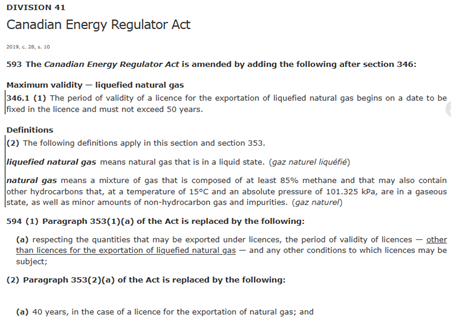
Before-and-After Comparison of Legislative Changes:
CER Act (Current) |
CER Act (Amendments) |
Explanation |
|---|---|---|
*NEW (N/A) |
Maximum validity — liquefied natural gas 346.1 (1) The period of validity of a licence for the exportation of liquefied natural gas begins on a date to be fixed in the licence and must not exceed 50 years. Definitions liquefied natural gas means natural gas that is in a liquid state (gaz naturel liquéfié) natural gas means a mixture of gas that is composed of at least 85% methane and that may also contain other hydrocarbons that, at a temperature of 15°C and an absolute pressure of 101.325 kPa, are in a gaseous state, as well as minor amounts of non-hydrocarbon gas and impurities (gaz naturel) |
The CER Act is amended by adding the following after section 346. |
|
353 (1) The Governor in Council may make regulations for the purposes of this Division, including regulations
|
Maximum validity — liquefied natural gas 353 (1) The Governor in Council may make regulations for the purposes of this Division, including regulations
|
The CER Act is amended by replacing paragraph 353(1)(a). |
|
Maximum validity
|
Maximum validity
|
The CER Act is amended by replacing paragraph 353(2)(a). |
First Hour
Natural Resources Canada (NRCan)
- Hon. Tim Hodgson, Minister
- Greg Orencsak, Deputy Minister
- Erin O'Brien, Assistant Deputy Minister, Fuels Sector
Second Hour
Canada Energy Regulator (CER)
- Tracy Sletto, CEO
- Darren Christie, Chief Economist
- Jonathan Timlin, Vice-President Systems Operations
Natural Resources Canada (NRCan)
- Erin O’Brien, Assistant Deputy Minister, Fuels Sector
Context
- On Tuesday, January 27, 2026, RNNR adopted the following motion:
- That the Committee agree to a subject matter study, for one meeting, of Bill C-15, specifically clauses 593 and 594 (Division 41); that it invite:
- the Minister of Energy and Natural Resources for one hour, and
- Tracy Sletto, Chief Executive Officer of the Canada Energy Regulator, for one hour, and that it forward any recommendations or suggested amendments to the Finance Committee by Thursday, February 27, 2026.
- That the Committee agree to a subject matter study, for one meeting, of Bill C-15, specifically clauses 593 and 594 (Division 41); that it invite:
- The CER, NRCan, and MPO officials appeared before the Senate Standing Committee on Energy, the Environment and Natural Resources (ENEV) on this measure on December 11, 2025.
- In addition to its examination of Bill C-15, RNNR is currently conducting a study on Canadian Energy Exports. Two meetings have been held on this study. Issues raised so far include forest biomass exports, electrification and future energy demands, pipeline investment and development, and foreign ownership of energy infrastructure. Notably, questions were raised regarding the competitiveness of LNG compared to other more cost-effective jurisdictions.
Committee Procedure
- You will have 5 minutes for your opening remarks. The committee will then proceed to questions and answers. In the House of Commons, the questioning tends to be more formal than in the Senate. Time limits are strictly enforced and Members will engage in political maneuvering.
- Following remarks, the committee will proceed with rounds of questions. Round one: CPC, LPC and BQ – six minutes each; all subsequent rounds: CPC and LPC – five minutes each; BQ – 2.5 minutes. In total, approximately four rounds of questions can be expected in the hour.
- Witnesses scheduled to appear before the Committee who wish to familiarize themselves with the general committee process may consult the Guide for Witnesses Appearing before House of Commons Committees.
Committee Environment & Context
- RNNR has a total membership of 10 Members of Parliament. The committee is composed of 5 Liberals (including the Chair), 4 Conservatives, and 1 Bloc Québécois. A profile of the committee, with bios and intel on each member, has been provided.
- Partly because this Government is in a minority position in the House of Commons, discussions around important policy issues, such as energy export policies, are typically quite heated. CER witnesses should expect for MPs to use this study to touch on a range of issues related to energy policy, Canadian sovereignty, regulatory policy, natural resource development, economic growth, the environment and climate change, and Reconciliation with Indigenous Peoples.
POTENTIAL QUESTIONS AND ANSWERS
Legislative Change Questions
Why is the CER Act being amended?
- As an arms-length regulator, the CER does not have a mandate to amend the CER Act. The Department of Natural Resources Canada (NRCan) led the proposed amendment so your questions on the reasons for the change should be directed to them.
Why 50 years over 40 years? Wasn’t 40 years long enough?
- I would defer to Natural Resources Canada for that question, as it speaks to the rationale for the change – and the CER did not develop this change.
Energy Transition Questions
Is Canada increasing the risk of stranded assets by increasing the maximum length of LNG export licenses?
- That is not something that the CER has assessed. We do not regulate the LNG export facilities -- we only grant licenses for the export of the actual molecules.
How will this extension affect Canada's net zero objectives based on your Energy Futures modelling?
- Our Energy Futures modeling did not assess this specific legislative change.
Based on your Energy Futures modelling, how do you think the global market will react to this extension? Is there global enough demand capacity to absorb this increase?
- Our Energy Futures modeling is focused only on Canadian supply and demand outcomes and doesn't directly assess the global market, including its reaction to specific Canadian legislative changes.
Domestic Impact Questions
Will increasing total LNG exports from Canada increase the cost of natural gas for Canadian homes and businesses?
- This would depend on a lot of factors and may depend on where you’re located in Canada.
- Overall, we expect North American gas prices to largely be driven by U.S. supply & demand for gas. This could include increased consumption for power generation (including for data centres) or to supply U.S. exports of LNG. We expect North American prices to be driven by U.S. supply and demand simply because U.S. gas demand is much larger than Canadian gas demand.
- For perspective, the U.S. exported about 12 Billion Cubic Feet per Day (Bcf/d) of LNG in 2024. During that time, Canadian production averaged 18 Bcf/d and total Canadian demand was only 12.5 Bcf/d. This means that the U.S. exported nearly as much natural gas as Canada consumed in 2024.
If pressed for more detail
- In western Canada:
- Prices have been very low in recent years - reaching negative price levels on multiple occasions - which cause gas producers to shut-in production. It has been difficult to get growing gas production out of western Canada, so when production grew above the domestic ability to consume or export it, the market became oversupplied with gas and western Canadian prices fell.
- Once LNG Canada comes fully online and new projects are added, the capacity to export increases and these pipeline bottlenecks may be relieved. This would increase gas prices in western Canada, probably to a level that’s more consistent with what other regions in North America pay for their gas supply.
- In eastern Canada:
- Eastern Canada can acquire gas supply from western Canada and the U.S, so its prices have been closely linked to U.S. gas prices (namely Henry Hub in the southern U.S.). We don’t expect this dynamic to change.
[If required to mention]
- The CER (and Minister of Natural Resources) have some legislative tools to act in the event gas exports leave Canadians deprived of gas supply. Namely:
- Section 348 allows the Commission, through an application or on its own initiative, to vary an export license. For changes that are not minor (such as changing an amount permitted to be exported), the Minister must approve.
- Section 349 allows the Commission, with approval of the Minister, to suspend or revoke an export licence if it’s in the public interest.
What impact will a 50-year LNG export licence have on domestic natural gas supply and prices for Canadians?
- In assessing any application for a 50-year licence, the Commission of the CER would assess the surplus test for the proposed volumes, as it has done for 40-year licences. So far, we have not had any major concerns about domestic supply and prices, and I think it’s likely that will continue to be the case with 50-year licences.
- Canadian gas markets are well integrated with U.S. gas markets via pipelines, making the gas market a North American gas market.
- Overall, because U.S. gas supply & demand is so much higher than Canadian supply & demand in this North American market, we largely expect that U.S. supply & demand for gas will drive prices more than Canadian LNG exports would, whatever the term of the Canadian licences.
What are the technical and economic impacts of having 40-year export licences for natural gas and 50-year licences for LNG exports?
- Defer to NRCan – I believe my colleagues at NRCan would be well placed to answer this question. My understanding is the department considered the potential impacts of this change when they were drafting it.
How does the Canadian case compare to Australia’s experience exporting LNG?
- East Australia saw greatly increased gas prices because of LNG exports. In 2018, some customers even had problems finding gas supply. Yet other parts of Australia that were exporting LNG did not have issues.
- Why did this happen in east Australia? Several reasons, many of which make it different than Canada:
- Export percentage: LNG exports make up roughly 70% of east Australia's gas market. When some domestic production was diverted from supplying domestic East Australian markets to supplying LNG exports, it had an oversized impact on domestic markets because they were relatively small: the loss of supply was relatively large to them and competition for the remaining gas was very high, causing prices to significantly jump.
- Canadian and U.S. LNG exports currently make up about one-tenth of the combined Canadian and U.S. gas market, which was 120 Bcf/d in 2024.
- Market Integration/Fragmentation: Australia’s gas market is fragmented into a few regions, which are poorly connected by pipelines, while Canada is part of a large North American market well integrated by pipelines. This integrated system allows gas to flow with minimal barriers across borders, to where the gas is needed and helps to make up any shortfalls.
- Resource Development Framework: East Australia's LNG exporters had locked up resource acreage and dedicated its production to exports. This meant that, during East Australia’s gas shortages of 2018, other producers had to scramble to acquire new acreage to produce new gas for the domestic market.
- Summary: Overall, the North American gas market is very large, well-functioning, integrated, liquid, transparent, and responsive to changes in supply and demand.
- Export percentage: LNG exports make up roughly 70% of east Australia's gas market. When some domestic production was diverted from supplying domestic East Australian markets to supplying LNG exports, it had an oversized impact on domestic markets because they were relatively small: the loss of supply was relatively large to them and competition for the remaining gas was very high, causing prices to significantly jump.
[if needed]
- In December 2025, the Australian government released a report in which they propose measures to address issues. The main conclusion is that the government should require East Australian LNG exporters to dedicate some of their gas supply for domestic markets (what they call a “gas reservation scheme”), like what is used other areas of Australia where LNG is exported. The report also recommends continuing to increase market transparency and liquidity. Canada, even when exporting about half of our gas production to the U.S., has never relied on a gas-reservation scheme to keep Canadian markets supplied with gas.
Regulatory Efficiency Questions
Will increasing the maximum length of licenses for exportation of LNG enhance regulatory efficiency?
- This change would decrease the potential number of extensions for their export licenses that LNG exporters would have to seek from the CER, thereby reducing administrative burden for those exporters.
Given your role providing Energy Information, can you please provide your views on whether this extension is likely to incentivize further investment and new LNG projects in Canada? Wouldn't regulatory reform to shorten approval periods and cut red tape be more beneficial?
- [Defer to NRCan]
- I appreciate your question. However, we have not modelled the potential impacts of this legislative change. Our colleagues from NRCan would be best placed to speak to the government’s policy objectives and analysis in regard to the development of additional LNG projects.
What about East Coast LNG? Why hasn’t it happened?
- A few projects have been proposed, but so far none have moved toward construction.
- To supply an East Coast LNG project with western Canadian gas production, producers must ship the gas all the way from western Canada. Then, of course, they’d have to pay a pipeline toll, which ends up being about C$4.50/GJ based on current tolling, which costs more than the gas itself.
- Together, the cost of gas supply and the pipeline toll for gas from western Canada is high enough that it makes it very hard for East Coast LNG to compete with LNG being exported from the U.S. Gulf Coast, which has significantly lower total supply cost (gas price plus pipeline toll).
Can this extension incentivize LNG projects in Eastern Canada (Quebec specifically)?
- This extension would apply for any LNG export projects in Quebec as well. That said, to supply an East Coast LNG project with western Canadian gas production, producers must ship the gas all the way from western Canada. Then, of course, they’d have to pay a pipeline toll, which ends up being about C$4.50/GJ based on current tolling, which costs more than the gas itself.
- Because of this, the cost of natural gas supply and the pipeline toll for gas from western Canada is high enough that it makes it very hard for East Coast LNG to compete with LNG being exported from the U.S. Gulf Coast, which has significantly lower supply cost (gas price plus pipeline toll).
How can the Building Canada Act (C-5) be expected to accelerate project reviews when the government acknowledges that existing federal laws impede development and with numerous natural resource projects currently awaiting federal regulatory decisions? Has the government taken the necessary steps to address the systemic barriers affecting proponents before the CER?
- For proponents before the CER, many of the fundamentals are already in place such as legislated time limits for CER decisions and clear service standards.
- The CER has been collaborating with the Major Projects Office on the overall process design and coordination under the Building Canada Act (BCA).
- If, in the future, a project in the CER’s jurisdiction is designated as a National Interest Project under the BCA, the CER will work closely with the MPO.
- The BCA explicitly sets out a role for the CER’s Commission in confirming that it is satisfied that issuing the final approval document for the project will not compromise safety or security.
- The CER is a lifecycle regulator and ensures that projects are built, operated and eventually abandoned safely.
- This lifecycle role remains the same, regardless of whether a project is a National Interest Project under the BCA or not.
Regulatory Performance Questions
There are currently 60 natural resource and energy projects stuck with federal regulators. Why are so many projects stuck with the CER and what are you doing to fix this issue?
- With respect, there are currently no projects currently paused, delayed, or stuck with the CER.
- From the 2019 fiscal year to the present, the CER has received and reviewed a total of 4,789 applications which include 1,111 project applications and 3,678 export/import applications.
- During this period, a total of 4,744 decisions were issued, which include 1,064 project related decisions and 3,680 export/import decisions, with 18 applications being denied.
- There are currently 85 active applications being processed and they are expected to meet all published service standards. These applications are on track and are not stuck.
- Since the 2019 fiscal year, the NEB and CER have met legislative time limits 99.3% of the time and met legislative service-standards 89.2% of the time for hearings and routine infrastructure applications (Categories A, B, and C), and 97.5% of the time for hearings, routine infrastructure, export orders, electricity exports, and COGOA applications.
How many export licenses has the CER issued since 2019? How many applications have there been?
- The CER has issued one licence for a new project since 2019 (Ksi Lisims). Otherwise, the CER has issued three licenses to replace existing 25-year licences with 40 year-licences (Woodfibre, Chevron, and Cedar 1). In January of this year, the CER issued a 40-year licence for Cedar 1 LNG, and Cedar 1 is expected to apply to rescind their 25-year export licence. In total, since 2019, there have been four applications for 40-year licences.
Can the CER implement this amendment? Does it affect its ability to assess exports?
- Yes, the CER can implement this amendment. Currently, under CER Act (S.C. 2019, c. 28, s. 10), the CER can grant export licences for natural gas exports up to 40 years, if our Commission is satisfied that the quantity of gas to be exported does not exceed the surplus remaining after estimated domestic demand. This is commonly known as the “surplus test.”
- The change in the maximum duration of licenses does not materially affect our ability to assess exports, though we will now have to estimate domestic demand in 50 years rather than 40.
We recently saw that the Cedar LNG export license decision was announced. Was that application approved for just 40 years?
- Yes, the licence that was recently approved is for 40 years. The CER’s Commission recommended the approval of a 40-year export licence for Cedar LNG on December 9, 2025, subject to approval by the Minister of Natural Resources. Minister Hodgson approved the CER’s recommendation on January 6, 2026, and Cedar LNG’s licence was issued on January 14, 2026. This 40-year licence will replace Cedar LNG’s 25-year licence.
Regulatory Process Questions
What is the process that a company follows when applying to the CER for a natural gas export licence?
- To apply for a natural gas export licence, companies must provide the CER’s Commission enough information to assess the surplus test and the specifics of their application. For example, this would include information like the source and volume of the gas they are planning to export, a description of gas supplies expected to be available to the Canadian market over the requested term of the licence, and the implications of the proposed export volumes for Canadians.
- For the purposes of an export licence application, the onus is on the Applicant to demonstrate that the criteria in section 345 of the CER Act are met. The filing requirements, by their very nature, are not prescriptive and can be met in a variety of ways, including quantitatively or qualitatively.
- When applying for export licenses, applicants should consider factors such as trends in Canadian natural gas demand and supply, historic trends in the discovery of Canadian natural gas resources, and how technology might impact future supply and demand for natural gas.
Does the CER expect companies to reapply for 50-year licenses? How long will these decisions take?
- Companies would have to apply for new 50-year licences if the CER Act is amended. They would not automatically receive them.
- The time it will take to make decisions on these applications would depend on how companies apply. After the last legislative change that extended these licences from 25 to 40 years, we received a total of five applications to replace 25-year licenses with 40-year licences over a period of about ten years.
- Given the pool of companies with 40-year licenses is shallow, with only 6 valid licences; and the remaining companies with 25-year licences have projects that have not moved forward in any material way, we expect we may only receive a handful of applications for 50 year licences if this change is made.
- For new export licence applications, the CER has legislated timelines of 180 days to make its determination after the application has been deemed complete. After the CER decision, the Minister of Energy and Natural Resources has 90 days to make a final decision.
The proposed change to the CER Act is one thing, but can’t the Building Canada Act “override” some or all of the CER Act?
- The CER has been collaborating with the MPO on overall process design and coordination under the BCA – to be prepared if a pipeline or power line under CER jurisdiction is designated as a National Interest Project.
- If, in the future, a project is designated as a National Interest Project under the BCA, the CER will continue to work closely with the MPO.
- The BCA explicitly sets out a role for the Commission in confirming that it is satisfied that issuing the final approval document will not compromise safety or security.
- The CER is a lifecycle regulator and ensures that projects are built, operated and eventually abandoned safely.
- This lifecycle role remains the same, regardless of whether a project is a National Interest Project under the BCA or not.
How does the CER consider impacts to the rights of Indigenous Peoples when considering natural gas export licences? Are any community impacts considered?
- The Commission is required, by s.56 of the CER Act, to consider any adverse effects that their decisions may have on the rights of Indigenous peoples. That said, the potential impacts of the export licences are generally minimal. When export terminals or other facilities are proposed, the appropriate regulator considers the impacts of those facilities.
KEY BRIEFINGS
A) CER Regulatory Requirements and Timing Statistics
Applications
- From the 2019 fiscal year to the present, the CER received and reviewed a total of 4,789 applications which include 1,111 project applications and 3,678 export/import applications.
- There are currently 85 active applications being processed.
- Note: this number refers only the applications the EABU reports on.
- During this period, a total of 4,744 decisions were issued, which include 1,064 project related decisions and 3,680 export/import decisions, with 18 applications being denied.
- Since the 2019 fiscal year, the NEB and CER have met legislative time limits 99.3% of the time and met legislative service-standard compliance of 89.2% for hearings and routine infrastructure (Categories A, B, and C), and 97.5% for hearings, routine infrastructure, export orders, electricity exports, and COGOA.
CER Adjudicative Timelines
Large Pipeline Project (>40km) Adjudication Timelines since 2019
- Since 2019, the CER has received 6 large pipeline applications, including:
- Edson Main Line Expansion: Completeness determination took 145 days & hearing phase took 451 days.
- North Corridor Expansion: Completeness determination took 144 days & hearing phase took 374 days.
- West Path Delivery 2023: Completeness determination took 154 days & hearing phase took 425 days.
- NEBC Connector: Completeness determination took 286 days & hearing phase took 413 days.
- Taylor to Gordondale Pipeline: Completeness determination took 157 days & hearing phase took 406 days.
- Sunrise Expansion Program: Completeness determination took 173 days & hearing phase took 420 days.
Small Project (<40km) Adjudication Timelines since 2019
- Average number of days to completeness determination:
- 2019 – 2020: 92 days
- 2020 – 2021: 77 days
- 2021 – 2022: 67 days
- 2022 – 2023: 78 days
- 2023 – 2024: 35 days
- 2024 – 2025: 30 days
Taken together, this indicates a downward trend over time. The CER has become more efficient at determining application completeness for small projects, especially in the last two years.
- Average number of days from application to decision:
- 2019 – 2020: 144 days
- 2020 – 2021: 169 days
- 2021 – 2022: 191 days
- 2022 – 2023: 121 days
- 2023 – 2024: 127 days
- 2024 – 2025: 111 days
B) Legislative/Drafting Context
Overview of Canadian Energy Regulator Act Amendments to Increase the Maximum Validity Period for LNG Export Licences
- As an independent agency, the CER was not involved in the policy decisions nor drafting of the proposed amendments. However, we are able to speak to the CER’s role in implementing the changes and its experience with export licences in general.
- The Commission of the CER currently has the authority to issue licences for the export of oil or gas, subject to the minister’s approval. The CER Act currently differentiates the maximum length of an export licence between the commodities: oil can be up to 25 years, natural gas up to 40 years.
- This differentiation began with an amendment to the National Energy Board Act in 2015. Prior to that time, both oil and gas export licences had a maximum duration of 25 years.
- The CER Act also contemplates regulations, which generally govern the information requirements and the terms and conditions for export licences. Further, the regulations allow the Commission to issue short-term orders for exports, generally for up to 2 years, without ministerial approval (National Energy Board Act Part VI (Oil and Gas) Regulations, s. 15).
- The current regulations were made under the National Energy Board Act and remain in force (as though they were made under the CER Act) until new regulations are made (Interpretation Act para. 44(g)).
- Updates to the regulations under the CER’s Export and Import Regulatory Framework have been under development in response to changes to the former NEB Act and the introduction of the CER Act. Proposed regulations were published in Canada Gazette, Part I and are currently under review before being finalized. The proposed regulations incorporate updates to align with the CER Act and increase clarity. The proposed regulations do not include any considerations around proposed changes to LNG licence maximum duration.
- Regarding the proposed regulations, for gas export licences including LNG, the key changes include:
- Streamlined application requirements to focus on surplus criteria as outlined in the CER Act as the only criterion for assessing oil and gas exports.
- Exemptions for in-transit activities and where the gas is in the tank of the vehicle for its own consumption.
- Align conditions and report requirements with the revised requirements outlined above.
- Regarding the proposed regulations, for gas export licences including LNG, the key changes include:
- The proposed amendments to the CER Act provide for a 50-year maximum period of validity for LNG exports. The change in the Act does not affect the Regulations, thus the updates to both documents will not inadvertently impact each other.
- The amendments to the Act specifically define “natural gas” and “liquefied natural gas”
- The proposed definition of natural gas is identical to the current definition of natural gas in the regulations.
- The 50-year maximum is restricted to liquefied natural gas exports only.
- Note that the Commission can also issue permits and licences for the export of electricity, though the provisions governing those are separate from oil and gas.
C) Recent Application Fact Sheets, including LNG Canada, Cedar LNG and Kitsault Energy LNG Canada:
LNG Canada:
- LNG Canada Development Inc. (LNG Canada) is the operator of the LNG Canada Liquified Natural Gas (LNG) export facility located in Kitimat, British Columbia.
- Joint venture partners:
- Shell Canada Energy,
- Petronas (North Montney LNG Limited Partnership),
- MidOcean (partially owned by Aramco, and who bought their stake from Petronas)
- Mitsubishi (Diamond LNG Canada Partnership),
- PetroChina Kitimat LNG Partnership, and
- Kogas Canada LNG Partnership.
- Currently, Shell is looking to sell up to 75% of its ownership stake and Mitsubishi is looking to sell some of its stake
- Possibly to raise funds to build Phase 2
- Project Phases:
- Phase 1: Trains 1 and 2 are finalizing commissioning and start-up activities, and export from Train 1 first occurred on 30 June 2025.
- Phase 2: an FID on Trains 3 and 4 is expected early 2026, for a possible early 2030s in-service date.
Licence GL-330 summary (as amended):
- 40-year term
- Maximum export quantity of LNG:
- Annually: 40.485 109 m3
- Total: 1,494 109 m3
Licence GL-330 history:
- LNG Canada’s original 25-year export licence GL-300 was issued (A50334-1 and A3F7H1). GL-300 was revoked in August 2016 following the issuance of GL-330 (A79097-1).
- In January 2016, the NEB approved LNG Canada’s application for a 40-year licence (A75001-1), and in May 2016, the Governor in Council approved the issuance of Licence GL-330 (A77188-3).
- In September 2017 the NEB approved an extension of the export commencement expiry date from 31 December 2022, to 31 December 2027 (A86081-1), and following GIC approval the NEB varied GL-330 accordingly (A89942-2).
- In July 2025, the Commission issued a decision approving, in part, LNG Canada’s application for confidentiality request on reporting data (C35803). Specifically, the Commission:
- Granted confidential treatment for information about the price or value and purchaser of LNG for a period of five years, without prejudice to LNG Canada to seek an additional period of confidential treatment;
- Denied confidential treatment for information about the country of destination, vessel name, and volume.
- On 4 November 2025 the Commission approved a 6.4% increase in the maximum annual quantity of LNG exported under the licence, with no change in the overall licence term quantity of 1,494 109 m3 (C37149-1). No Ministerial approval was required, as this variance was determined by the Commission to be minor.
Cedar 1 LNG
- The Cedar Group (which includes Cedar 1 and the Cedar LNG Project) is a majority-Indigenous owned partnership between the Haisla Nation and Pembina Pipeline Corporation.
- Note that the project and facility itself do not fall under CER jurisdiction. Those approvals are already secured.
- The facility will have a floating LNG liquefaction unit that will be powered by a BC Hydro transmission line and fed by the Coast Gaslink pipeline.
Overview
- Cedar 1 LNG Export Ltd. (Cedar 1) has a 40-year licence (C34172) to export liquefied natural gas (LNG) from the Cedar LNG facility currently under construction in the traditional territory of the Haisla Nation, in the vicinity of Kitimat, BC. The terminal is located at a deepwater port in the Northern Douglas Channel.
Summary:
- 40-year term
- Maximum export quantity of LNG:
- Annually: 8,550,000,000 m3 (including 15 per cent annual tolerance),
- Total: 342,000,000,000 m3 (including the 15 per cent tolerance).
Application:
- Cedar 1 held an existing long-term export licence for the same quantity and export point, for a term of 25 years – the maximum allowable term at the time of its application for that licence in 2015. Shortly after submitting that application, the maximum allowable term was increased to 40 years for LNG exports.
- As part of its application to extend its term from 25 to 40 years, Cedar 1 asked for the CER to exercise its authority under section 350 of the CER Act to revoke the existing licence once the new 40-year licence is issued and the appeal/judicial review window has closed, but this licence has not been revoked yet.
- The Commission approved a 40-year licence for Cedar 1 on 9 December 2025, (finding that the LNG exports proposed by Cedar 1 are surplus to Canadian requirements for the term of the licence, plus a sunset clause of 10 years from the date of issuance).
- The Minister of Energy and Natural Resources approved issuance of the 40-year licence on January 9, 2026, and the Commission issued the 40-year licence on January 14, 2026.
Kitsault Energy
- On 22 December 2025, Kitsault Energy applied for a 40-year licence to export up to 40 million tonnes per annum (~ 5 Bcf/d) of LNG from Kitsault, BC. The Commission is currently considering the completeness of the application, and has yet to confirm whether the application is complete.
Kitimat LNG (Bish LNG – Haisla Nation)
- On 17 September 2025, Chevron applied to the Commission for approval to transfer its 40-year licence (GL-343) to Bish LNG GP Ltd. The licence is associated with what was anticipated to be the Kitimat LNG Project. Bish LNG, the purchaser, is indirectly owned by the Haisla Nation, in whose territory the assets of the Kitimat LNG Project are located. The Commission approved the application on 21 November 2025, subject to closing of the transaction, which has not yet occurred.
Six approved and valid 40-year export licences:
Licensee |
License Issued |
Varied |
Licence Number |
Annual Quantity (Bcf/d) |
Term Quantity (Tcf) |
|---|---|---|---|---|---|
| LNG Canada | 5/27/2016 | 11/4/2025 | 330 | 3.92 | 53 |
| Pacific NW LNG | 12/21/2016 | 337 | 3.4 | 48 | |
| Woodfibre | 6/9/2017 | 340 | 0.32 | 5 | |
| Chevron* | 3/11/2020 | 343 | 2.7 | 35 | |
| Ksi Lisims | 3/15/2023 | 346 | 2.2 | 27 | |
| Cedar 1 LNG | 1/14/2026 | 349 | 0.8 | 12 | |
| Total | 13.3 | 180 |
- * Chevron’s licence will transfer to Bish LNG upon closing of their corporate transaction.
- ** Not shown above is a licence that used to be held by WCC LNG (ExxonMobil project), which canceled its LNG project and applied to the Commission to revoke its licence in 2016, which the Commission approved on January 12, 2017. WCC annual limits would have been 4.6 Bcf/d with a term limit of 64 Tcf.
D) Regulatory Information
- The process to acquire a licence:
- Apply to the Commission
- Provide the:
- Term requested
- Sunset-clause duration requested
- Maximum exports over the term
- Maximum annual exports
- Export point(s)
- Discuss how Canadians will be affected if the applied-for exports proceed
- Usually through a market study
- Provide the:
- Once all requisite information has been filed, the Commission will deem the application is complete. The Commission has 180 days to render its decision from the date the application is deemed complete.
- Commission requires publication of notice in major news outlets by the applicant advising that the Commission is seeking comments with respect to the surplus test, and indicating the Commission will not consider comments relating to other matters (see for example recent Cedar 1 direction on publication: https://apps.rec-cer.gc.ca/REGDOCS/File/Download/4576181).
- Commenters send letters (if any)
- Commission can pose questions to the applicant to fill in gaps in the application or to seek clarity, to date via written requests for information
- Commission considers comments and full evidentiary record when deciding
- Commission publishes its decision and simultaneously forwards the decision to the Minister for their consideration.
- Within 90 days of the Commission’s decision, the Minister makes their decision. If the Minister’s decision is to approve the licence, the Commission issues the licence within 7 days.
- Alternatively, a company with an existing licence might choose to apply to vary its existing licence, rather than apply for a new licence. For variance applications, there are some key differences:
- Historically, the Commission has only invited comments from parties who commented in the original application, without requiring more broad publication;
- There are no legislated time limits;
- For applications deemed by the Commission to be neither minor nor technical, Ministerial approval is required. For minor variance applications, the Commission has the authority to decide on the variance with no Ministerial approval required.
- Apply to the Commission
- The NEB/CER:
- Since the Jobs, Growth, and Prosperity Act (JGPA) in 2012, the NEB/CER has granted 37 licenses to export gas (25 years and not including NGLs), and 7 licenses to export natural gas (40 years)
- 24 of these licenses remain valid (17 gas and 7 natural gas).
- Revoked 10 licences, normally so a 25-year licence could be replaced by a 40-year licence, though a few were revoked because licence-holders requested it after they canceled their LNG projects
- Four licences approved after JGPA have expired, with about 15 more set to expire before the end of 2026
- Licences come with “sunset clauses”, which cause licences to expire if unused for a number of years after approval (typically 10 years for LNG-export facilities given the long time needed to permit and build them). This means unused licences don’t last forever.
- Companies can always apply to extend their sunset clause and the Commission and Board granted many of these requests.
- Currently, only one 40-year licence is active (LNG Canada’s, which is the only facility that has exported LNG under a 40-year license) and no 25-year licences to export gas are active other than for NGLs.
- Total export volumes permitted under all licences (25-year and 40-year) to export gas since Jobs, Growth, and Prosperity Act updated NEB Act to remove all explicit consideration criteria except for the consideration of the Surplus criterion (not including NGLs, and where valid = not expired and not revoked)
Count all
Count Valid
All Annual (Bcf/d)
Annual Valid (Bcf/d)
All Term (Tcf)
Term Valid (Tcf)
Eastern Canada 6 6 8.2 8.2 72.1 72.1 Western Canada 31 18 47.2 25.7 521.9 306.2 Total 37 24 55.4 33.9 594.0 378.3 - Note: Western Canada includes 2.3 Bcf/d (21 Tcf term) exported to US PNW for re-export
- 2 licenses related to LNG exports were granted prior to 2012, for a total of 1.5 Bcf/d (24 Tcf term)
- Volumes permitted under valid 40-year licenses: 13.3 Bcf/d
- LNG Canada, Woodfibre, Ksi Lisims, Pacific Northwest (Petronas), Chevron, and Cedar LNG
- WCC LNG (ExxonMobil)’s licence was revoked at their request (project canceled); with WCC LNG, total 40-year licences including this would be 17.9 Bcf/d
- Since the Jobs, Growth, and Prosperity Act (JGPA) in 2012, the NEB/CER has granted 37 licenses to export gas (25 years and not including NGLs), and 7 licenses to export natural gas (40 years)
- The surplus test
- The CER Act only explicitly requires the Commission to consider whether gas proposed for export is surplus to Canadian requirements. Note that a licence for export does not authorize any facilities or production – other authorizations would be required to produce the gas, ship it, or process it.
- The Commission (and its predecessor, the NEB) considered each application on its own merits, and within the context of a functioning, Canadian and North American gas market.
- The Commission (and the NEB) did not sum prior, permitted exports when considering whether applied-for volumes would be surplus to Canadian requirements, as not all projects would be built nor their licences fully used.
- The Board/Commission has not been in the business of counting molecules.
- For context, the first application the NEB received after the Jobs, Growth, and Long-term Prosperity Act of 2012 amended the NEB Act to focus on the surplus criterion for export licenses, came from LNG Canada, which is the first facility to be built. The last new applicant? Ksi Lisims applied in 2023 for a 40-year licence and is a serious contender for construction today.
- At the time, nobody knew if it would be the first project through the door that was built first or the last one.
- The CER has two permit types which can be used to export natural gas
- Export orders, which are two-years are less. These are mostly administrative in nature to acquire, and are generally granted in 2 days if the application is complete (name, address, and volumes exported must be reported).
- Licences (25 years or 40 years or now 50 years). These have a higher bar, requiring a market-impacts study to show that, over the long term, Canadians will still have access to adequate supplies of natural gas.
- The CER (and Minister of Natural Resources) have some legislative tools to act in the event gas exports leave Canadians deprived of gas supply
- Section 348 allows the Commission to, through an application or on its own initiative, to vary an export licence. For changes that are not minor (such as significantly changing an amount permitted to be exported), the Minister must approve.
- Section 349 allows the Commission, with approval of the Minister, to suspend or revoke a licence if it’s in the public interest.
- The Commission (and NEB) has consistently made certain findings in approving licences:
- Canadian and North American gas markets are large, integrated, transparent, liquid, responsive, and flexible. Within this highly efficient market, gas flows to where it is most valued and Canadians get their gas supply.
- Canadian gas markets have not experienced any major, long-term dysfunction since they were deregulated in the mid-1980s.
- The gas resource in North America is very large and can accommodate gas demand plus LNG exports well into the future.
- Cumulative licensed volumes is not helpful in determining whether applied-for export volumes are surplus to Canadian requirements. Not every project will be built nor their licences used to their full extent. Markets are best at deciding which projects have the most merit.
E) Summary of Previous CER Senate Appearance on the proposed change to the CER Act
ISSUE
The Standing Senate Committee on Energy, the Environment and Natural Resources (ENEV) invited the CER to appear on December 11, 2025, as part of its study on Divisions 32, 40, 41 and 42 of Part 5 of Bill C-15 (the budget implementation Act). Specifically, ENEV had questions about Part 5, Division 41, which, “amends the Canadian Energy Regulator Act to set the maximum duration of licences for the exportation of liquefied natural gas at 50 years” rather than the current 40 years. The CER was represented by our Chief Economist, Darren Christie and by our Technical Leader for Hydrocarbon Resources, Mike Johnson. They were joined by ADM Erin O’Brien from NRCan’s Fuels Sector and Peter Feldberg, VP Regulatory Affairs, at the Major Projects Office (MPO). You can watch the full appearance here.
SUMMARY
In her opening remarks, Erin O’Brien from NRCan provided context on Canada’s liquefied natural gas (LNG) sector, noting Canada is the world’s fifth-largest natural gas producer with significant gas reserves and other advantages such as low production costs, short shipping routes to Asia, and strong emissions performance. O'Brien told Senators that LNG demand is projected to grow globally, and that Canada’s first LNG export facility began operations in 2025. She told Senators that the proposed amendment to the CER Act will help Canadian projects compete globally by allowing companies to amortize upfront costs over a longer duration, and by supporting phased developments for LNG projects. She said that all new export licence applications will still be subject to a surplus test to ensure that natural gas exports do not exceed domestic needs.
In his opening remarks, Darren Christie described the CER’s mandate and explained how we oversee exports of hydrocarbons, including LNG. He then detailed the framework for natural gas exports, which currently allows licences of up to 40 years with ministerial approval, based on a surplus criterion that is designed to ensure Canadian energy needs are met. Christie made it clear that as an independent regulator, the CER did not draft the proposed amendment to the CER Act.
In his opening remarks, Peter Fedlberg covered the MPO’s mandate and spoke about some of their recent activities, including the first two tranches of major projects that had been submitted to them for potential designation in the national interest. He then spoke about a minor amendment to the Building Canada Act that is proposed by Division 40 of Bill C-15. He explained this amendment corrects a reporting requirement to ensure all five designation criteria are reflected in the public notice that MPO will provide after a project is designated. Feldberg told Senators that the MPO believes extending the maximum duration of LNG export licences to 50 years via the proposed amendment to the CER Act will help support investment certainty for Canadian LNG projects.
QUESTIONS FROM THE COMMITTEE
The Senators’ questions were mainly technical in nature and included how NRCan develops its global LNG demand forecasts, what Canada’s competitiveness is in the global market, and what the impacts of LNG projects are for local communities and Indigenous Peoples.
Questions directed to the CER:
- Following the adoption of this CER Act amendment, how does Canada’s regulatory export regime compare to other countries such as Australia?
- Will the current export licence holders automatically get an extension to 50 years with this amendment?
- Does the projected 160 years of natural gas supply available (that NRCan referenced) include offshore natural gas resources in Newfoundland and Labrador?
- When the CER’s Commission considers the surplus test for export licence applications, does it look at the absolute availability of natural gas resources or the economically available natural gas resources?
- Does the CER have an oversight process that continues through the 50-year licence period and which makes sure that the proponent is behaving properly?
Questions directed to NRCan that may be relevant for the CER:
- Where does NRCan get its projections for future global natural gas demand from?
- NRCan said it uses a range of private and public forecasts and will submit these to the Committee in writing.
- There were two LNG export projects in Nova Scotia (NS) that were cancelled. Wouldn’t it be beneficial to have more export capacity in NS given its proximity to Europe?
- NRCan explained that export licences can be issued for any number of projects across Canada, but those must be applied for by exporting companies.
- Could this extension be considered an Inefficient Fossil Fuel Subsidy?
- NRCan responded that they didn’t believe this change would fit the definition of a subsidy.
- What are the impacts for Indigenous Peoples for the proposed CER Act change and for LNG projects generally?
- NRCan answered that Crown Consultation (CC) occurs as part of the provincial and/or federal impact assessments for the LNG export facilities and related infrastructure. This CC is part of meaningful dialogue on the potential impacts of LNG export facilities and how to accommodate or mitigate those.
- NRCan said they sent letters to Indigenous communities concerning the proposed change to the CER Act to fulfill their UNDA responsibilities for legislative change, but had not heard back from any communities. NRCan said they assessed their obligations for engagement on this change to be limited.
F) Summary of RNNR Meeting on Canadian Energy Exports, Feb 3
ISSUE
On February 3, 2026, RNNR held its first meeting on a new study of Canadian Energy Exports. You can watch the meeting here. The session focused on Canada's global standing as an energy exporter, its potential to become an energy superpower, US-Canada relations, and the nature of Canada's energy exports today. MP questions focused on the future of the global energy market, job creation through energy exports, and the government's strategy for energy exports. The first two witnesses, Normand Mousseau and Pierre-Olivier Pineau, were fairly critical of Canada's current strategy for energy exports and the continued development of LNG and oil infrastructure. They advocated instead for research and development in green energy technologies. Witnesses in the second half of the session, Hon. Dan McTeague and Heather Exner-Pirot, were also critical of the government's strategy, yet disagreed with the first two witnesses, arguing instead for streamlining regulations and creating more incentives for investors in Canadian oil and gas.
WITNESS REMARKS
Normand Mousseau, Professor, Université de Montréal:
While Canada is a major energy producer, it is not an energy superpower. Due to its heavy reliance on the American market and its relatively expensive energy products, it is not as competitive as other alternatives. Canada has also fallen behind on the future of the energy market, failing to stay competitive on green energy. The lack of diversification in Canda's current energy exports also poses an issue that cannot be easily or quickly resolved. Canada's recent investments in LNG and oil and gas infrastructure is also a misstep as global markets are moving towards electrification and green energy, while overproduction of oil and gas products will lessen demand. To become an energy superpower, Canada will need to invest in research and development of new technologies for green energy.
Pierre-Olivier Pineau, Professor, Chair in Energy Sector Management, HEC Montréal:
Natural gas prices have been in dramatic decline and have not recovered to pre-2009 levels. The combination of low global prices and high production costs put a unique strain on Canada's oil and gas products. This is coupled with the fact that global demand for diesel and gasoline is also in decline. Overproduction and overinvestment in LNG can have dire consequences in the future, and the recent push for such investment by Canada is a misstep. What is needed is push for energy efficiency and reduction in consumption to allow more room for growth and exports. Integration of provincial and North American electricity grids can be very beneficial toward this aim. We should develop Canadian niches and move with the world towards green energy. Recommendation: Canada should move away from oil exports and develop productivity and green energy technology.
Hon. Dan McTeague, President of Canadians for Affordable Energy:
Energy exports constitute 29% of all Canadian exports. Canada has some of the cleanest oil and gas energy products that provide income to Canadian families. As global demand for hydrocarbon products increases, and the geopolitical landscape shifts, Canada must step up and provide for that demand. Net-zero objectives hurt Canada's economy and act as a barrier to Canadian energy exports. Defending the oil and gas industry is necessary for Canada as it can help significantly with the cost-of-living crisis.
Heather Exner-Pirot, Director of Energy, Natural Resources and Environment at Macdonald-Laurier Institute:
Canada is a world class energy exporter, yet it lacks the regulatory stability and predictability to attract private investment. Current federal regulations discourage capital investment, signaling that Canada is not "open for business". It is crucial that major regulatory reforms are put in place to attract investment and ramp up oil and gas infrastructure construction. Many investors have crossed out Canada completely, opting for investments in the US instead. It is crucial for Canada's geopolitical standing that oil and gas exports are further developed.
RELEVANCE FOR THE CER
Important questions regarding federal regulation of oil and gas exports were raised, and LNG exports were a main point of discussion. While the CER was not specifically mentioned, the current federal regulatory framework was identified as a main barrier to further development of Canada's oil and gas exports by witnesses Hon. Dan McTeague and Heather Exner-Pirot, as well as by the Conservative Acting RNNR Chair, Shannon Stubbs.
G) Summary of RNNR Meeting on Canadian Energy Exports, Feb 5
ISSUE
On February 5, 2026, Standing Committee on Natural Resources (RNNR) held its second meeting on the study of Canadian Energy Exports. You can watch the meeting here. The session focused on manufacturing and oil and gas sector exports, Regulatory reform, US-Canada trade relations, electrification, the new Major Projects Office, and bill C-5. First witness, Lisa Baiton, President and Chief Executive Officer of Canadian Association of Petroleum Producers, discussed the concerns of the oil and gas sector and advocated for more oil and gas infrastructure and exports. Second witness, Catherine Swift, President of Coalition of Concerned Manufacturers and Businesses of Canada, discussed the concerns of the manufacturing sector, its collaborative relationship with the oil and gas sector, and voiced criticism of the governments regulatory and policy strategy, especially bill C-5. The third witness, Francis Bradley, President and Chief Executive Officer of Electricity Canada, discussed export potential in the electricity sector, and the importance of electrification and grid integration within Canada.
WITNESS REMARKS
First witness, Lisa Baiton, President and Chief Executive Officer of Canadian Association of Petroleum Producers
Expanding oil and gas exports is a sure way of raising productivity, strengthening our economy, and exercising our sovereignty. Global energy consumption is on the rise and hydrocarbon demand will be there for decades. There are major benefits to increasing oil and gas exports: 1. It allows us to diversify our market and strengthen our economic independence 2. It enriches the government through royalties and taxes 3. The oil and gas sector is a major job creator. For Canada to step up and meet this demand; it must choose to do so. We must avoid laws and regulations that increase costs and compliance burden on the industry, such as the new changes to the methane regulation and carbon pricing. We need a new policy approach that can attract investments and unleash oil and gas exports.
Catherine Swift, President of Coalition of Concerned Manufacturers and Businesses of Canada
Canadian manufacturing is decreasing in size. It used to account for roughly 20% of GDP; now it hovers around 10%. The energy industry and manufacturing industry are closely linked and will need to be developed together. Integration of China into the global market was a huge blow to Canada's manufacturing, and the governments new position to create closer links with China is misguided. For years, 'green" policies have led to decreases in productivity and an increase in costs for the oil and gas and manufacturing sectors. Manufacturers welcome new export projects proposed by the government, yet these new projects have been using manufactured goods from abroad. Failure of government policy on oil and gas and manufacturing is a key reason for weakness in the Canadian economy today. On bill C-5, instead of getting rid of laws itself admits to being a barrier to growth, the government has only repackaged them and added more red tape. The bill also facilitates winner picking by the government, such as with the EV battery sector. It is naive to imply that Canada can replace trade with the US. Uncompetitive laws are at fault not the Trump administration.
Francis Bradley, President and Chief Executive Officer of Electricity Canada
Electrification is an important aspect of Canada's ambitions of becoming an energy superpower. Canada is a net exporter of energy, mostly to the US, and has one of the cleanest electricity grids in the world. While exports have decreased recently, they are still integral to our economic growth. Electricity must be developed side by side with other national priorities. Demand is expected to double and to meet demand we must build more electricity infrastructure. Key recommendations for Canada: 1. modernise regulations for electricity projects (two-year approval process) 2. mobilize capital for investment in those projects 3. strengthen capacity and resilience through inter-provincial grid integration.
RELEVANCE FOR CER
Many of the questions from Vice-Chair Shannon Stubbs(C) were focused on Canada's regulatory system. MP Stubbs mentioned that around 60 projects are still pending approval and being blocked by regulatory bodies such as the CER. Witnesses from the oil and gas and manufacturing industries were also very critical of the regulatory status quo, and the new bill C-5. Francis Bradley, president of Electricity Canada, discussed the benefits of interprovincial grid integration and electricity exports for Canada's future. He mentioned that regulatory reforms are needed for further development of electricity projects.
H) Projects in the National Interest
How will the recently announced MOU between Alberta and the Federal Government impact the CER, and will the proposed pipeline be regulated by you?
- The CER regulates energy infrastructure in federal jurisdiction throughout its lifecycle, including pipelines that cross provincial or international borders, as well as international powerlines.
- As a lifecycle regulator, the CER ensures that energy projects are built, operated, and abandoned safely. Safety and environmental protection are central to the CER’s mandate.
- We understand, based on the MOU, that the proposed pipeline would cross Alberta and British Columbia though the exact route is unknown.
- If the proposed pipeline comes to fruition and is designated as a National Interest Project under the BCA by the Major Project Office (MPO), the CER will work closely with the MPO and other Federal agencies as needed, to support its review and assessment.
- Depending on the project’s scope, assessments would be conducted through different regulatory pathways: projects involving more than 75 km of new right-of-way undergo an integrated review process led by the Impact Assessment Agency with CER involvement, while those under 75 km of new right-of-way are assessed solely by the CER.
- The CER has been collaborating with the MPO on overall process design and coordination under the BCA.
Can the BCA “override” some or all of the CER Act?
- The CER has been collaborating with the MPO on overall process design and coordination under the BCA – in case a project under the CER jurisdiction is proposed as a National Interest Project.
- If, in the future, a project is designated as a National Interest Project under the BCA, the CER will work closely with the MPO.
- The BCA explicitly sets out a role for the Commission in confirming that it is satisfied that issuing the final approval document will not compromise safety or security.
- The CER is a lifecycle regulator and ensures that projects are built, operated and eventually abandoned safely.
- This lifecycle role remains the same, regardless of whether a project is a National Interest Project under the BCA is not.
ENVIRONMENTAL SCAN
Environmental Scan: House of Commons Standing Committee on Natural Resources (RNNR) Appearance, February 12, 2026
Purpose
To provide background information on the current environment prior to the CER’s appearance before the The House of Commons Standing Committee on Natural Resources (RNNR) on Thursday, February 12, 2026. This document specifically focuses on the proposed amendment to the maximum duration of liquefied natural gas (LNG) export licenses. The information is based on public government and media statements from approximately November 2025 to February 2026.
Summary
Recent months have seen a renewed push to fast-track major LNG projects, expand export capacity, and deepen trade ties with Asian and European markets. However, these ambitions are met with ongoing debate over climate impacts, market volatility, and the long-term competitiveness of Canadian LNG.
Key Themes
- Export Market Startup and Expansion:
- LNG Canada (Kitimat, BC) shipped its first cargo in mid-2025 and is ramping up production, with Phase 2 and other projects (Cedar LNG, Woodfibre LNG) advancing toward final investment decisions and construction.
- New proposals are emerging, including Marinvest’s mega-project in Baie-Comeau, Quebec, which is being promoted as a strategic gateway to the European market. The project is in early consultation stages with Indigenous communities and stakeholders, and think tanks are calling for its fast-tracking.
- Kitsault Energy is lobbying for a dual pipeline corridor to BC’s northwest coast, aiming to export both LNG and butanol, with a focus on Asian markets and First Nations partnerships.
- Economic opportunity and energy security
- LNG projects are framed as nation-building opportunities to “turbocharge” the economy, attract billions in investment, and support reconciliation with Indigenous communities through equity partnerships and job creation.
- Depressed natural gas prices and lower capital spending in late 2025 have led to reduced drilling and output, but optimism remains high for a rebound as new export capacity comes online in 2026–2028.
- Canada is actively seeking to diversify export markets, with a major diplomatic push to expand LNG and oil trade with India and the EU, reducing reliance on the US and responding to shifting global energy alliances.
- The EU is looking to Canada as a potential alternative to US and Russian LNG, while India is being courted as a key growth market, though analysts caution that Canadian LNG may be too expensive for some Asian buyers.
- Climate Considerations
- Multiple independent reviews and media reports highlight the risk that new LNG projects could negate emission reductions in other sectors, threatening BC’s and Canada’s climate targets.
- The CleanBC review and other expert commentary warn that the province’s LNG ambitions could add up to 13 megatonnes of emissions annually, undermining progress toward 2030 goals.
- Proponents argue that electrification and new technologies can mitigate some emissions, but critics say the scale of expansion is incompatible with climate leadership.
- Environmental compliance issues, such as Woodfibre LNG’s salmon monitoring infraction, and debates over the social and community impacts of large-scale projects (e.g., “floatel” worker housing) remain in the spotlight.
- Political and Regulatory Developments
- The federal government’s Major Projects Office is positioned as a “single point of contact” to streamline approvals for projects deemed of national interest
- Alberta and the Federal government have signed an agreement to streamline approvals for energy projects.
- In Quebec, the Parti Québécois and other parties are showing openness to new infrastructure if it supports economic development.
- Ongoing regulatory scrutiny and Indigenous consultation are central to project advancement, with some projects (e.g., Cedar LNG) securing long-term commercial agreements and moving toward construction.
Recent Media Stories
- “A Smart Win for Canada, Alberta, and First Nations--the Kitsault Energy Project (Financial Post, Feb 5, 2026)
- “Report calls for fast-track of Quebec LNG project” (National Post, Feb 4, 2026)
- “Analysts caution feds against big bet on Indian LNG market” (National Observer, Feb 4, 2026)
- “EU Fears Dependence on U.S. LNG, Looks to Canada” (The Energy Mix, Feb 4, 2026)
- “Think tank touts Quebec LNG proposal as gateway to European market” (National Post, Feb 5, 2026)
- “LNG facilities B.C. will add significant new sources of climate pollution: report” (Castanet, Feb 3, 2026)
- “Canada Aims for More LNG Exports to India as Carney Plans Visit” (Financial Post, Jan 30, 2026)
- “EU eyes gas from Canada and Qatar to reduce reliance on U.S. LNG” (Financial Post, Jan 28, 2026)
- “Canada, India agree to expand oil, LNG trade in renewed energy push” (Western Standard, Jan 27, 2026)15
- “Canada to boost oil and gas exports to India as relations thaw” (National Post, Jan 26, 2026)
- “The owner of this B.C. ghost town wants to make it a Canadian energy hub” (Vancouver Sun, Jan 10, 2026)
- “How B.C. LNG projects could enefit from referral to federal major projects office” (Vancouver Sun, Jan 7, 2026)
- “World watches as Ottawa's bullish shift on LNG puts wind at the back of two major projects” (Financial Post, Dec 17, 2025)
- “Ovintiv signs on to Cedar LNG project as long-term customer” (Financial Post, Dec 16, 2025)
- “Pembina Announces 2026 Guidance, Agreement for Cedar Capacity, and Business Update” (Financial Post, Dec 15, 2026)
- “Canadian oilsands majors aim to hold spending steady as broader industry braces for tough year” (Financial Post, Dec 11, 2025)
- “We asked three experts to weigh in on the pipeline MOU. It got a bit testy” (Financial Post, Dec 9, 2025)
- “Key ministers address Assembly of First Nations in Ottawa after Hodgson is bumped” (Toronto Star, Dec 4, 2025)
- Natural resources minister takes heat from B.C. chiefs over potential West Coast pipeline” (CBC News, Dec 4, 2025)
- “Alberta energy deal was 'the last straw,' says Guilbeault after cabinet resignation” (CBC News, Dec 1, 2025)
- “Federal government and Alberta agree to new energy collaboration” (Canadian Manufacturing, Dec 1, 2025)
- “Alberta-Ottawa energy agreement draws mixed industry and environmental reactions” (BNN Bloomberg, Nov 29, 2025)
- “CTV National News: Reaction to Alberta–Canada energy agreement” (CTV National News, Nov 29, 2025)
- “Energy minister apologizes after suggesting Coastal First Nations could meet by Zoom over pipeline concerns (National Post, Nov 29, 2025)
- “Guilbeault resigns from cabinet over Carney’s energy deal with Alberta” (CTV News, Nov 28, 2025)
- “Guilbeault resigning from cabinet over energy deal with Alberta: source” (CBC News, Nov 27, 2025)
- “Guilbeault quits Carney’s cabinet over energy deal with Alberta” (CBC News, Nov 27, 2025)
- “Enserva’s 2025-2026 State of the Industry Report Highlights Shifting Market Conditions and Emerging Opportunities for Canadian Energy Services” (Toronto Star, Nov 26, 2026)
- “Energy service group predicts lower industry spending, but sees reason for optimism” (Canadian Press, Nov 26, 2026)
- “Krishnan Suthanthiran Highlights Canada's Clean-Energy Future and Opportunities for First Nations Communities and Canada–India Collaboration” (Financial Post, Nov 20, 2026)
- “Oil and gas producers applaud Ottawa’s latest major projects list” (Winnipeg Free Press, Nov 14, 2025)
- “Opinion: The budget is done. Start building, baby” (Financial Post, Nov 12, 2026)
- Marinvest promoted its mega LNG project in Baie-Comeau during a 'Quebec Canada mission'” (National Observer, Feb 4, 2026)
- “Review of B.C.'s emissions recommends renewed efforts as critics say LNG stands in way of progress” (CBC, Nov 27, 2025)
Additional Sources
- Report: A Liquefied Natural Gas Plant: A Priority Project for Quebec (MEI, Feb 5, 2026)
- Enserva’s 2025–2026 State of the Industry Report (Nov 26, 2025)
- Rising to the Moment: Renewing CleanBC to improve afforadabiltity, strengthen the economy and ensure a cleaner future (CleanBC, Nov 2025)
- Prime Minister Carney announces second tranche of nation-building projects referred to the Major Projects Office (Major Projects Office of Canada, Nov 13, 2026)
- Date modified: