
Canada Energy Regulator 2025–26 Departmental Results Report
On this page
- At a glance
- Message from the Interim Chairperson
- Message from the Chief Executive Officer
- Results – what we achieved
- Core responsibility 1: Energy Adjudication
- Core responsibility 2: Safety and Environment Oversight
- Core responsibility 3: Engagement
- Core responsibility 4: Energy Information
- Internal services
- Spending and human resources
- Supplementary information tables
- Federal tax expenditures
- Corporate information
- Definitions
Copyright/Permission to Reproduce
ISSN 2563-3244
At a glance
This departmental results report details the Canada Energy Regulator’s (CER) actual accomplishments against the plans, priorities and expected results outlined in its 2025-26 Departmental Plan.
These results align with the priorities outlined in the May 21, 2025, mandate letter from the Prime Minister, as well as with the CER’s vision, mission, raison d’etre and operating context.
Key priorities
The CER’s Board of Directors identified the following key priorities for 2025-26 as part of its 2024-27 Strategic Plan:
- Trust and Confidence: We foster the trust and confidence of Canadians by effectively delivering on our mission with safety at the forefront. We engage and empower our diverse workforce. We strengthen relationships that uphold the rights and interests of First Nations, Inuit and Métis, and we communicate transparently and engage meaningfully with all our stakeholders.
- Reconciliation and Implementing the UN Declaration: We are implementing the United Nations (UN) Declaration on the Rights of Indigenous Peoples (UN Declaration) and delivering on the commitments made in the UN Declaration Act Action Plan. We do so based on the recognition of rights, respect, co-operation and partnership, by working together with First Nations, Inuit and Métis governments, communities, and organizations. We continue to build the cultural intelligence of the CER.
- Competitiveness and Regulatory Excellence: We enhance Canada’s global competitiveness through leadership in regulatory innovation and best practices, focusing on cost-effectiveness, transparency, predictability, timeliness and efficiency of regulatory processes.
- Preparing for the Energy Future: We inform the energy transition by offering expertise and insight as the energy system transitions to a net zero economy across Canada. We focus on energy innovation, security, competitiveness, and safe and reliable energy transmission infrastructure that is resilient to the effects of climate change.
Highlights
Over the past year, the CER has been focused on delivering its mandate with excellence and innovative approaches. There are several highlights to note, including completing two major pipeline reviews ahead of their 18 month legislated timelines, several adjudicative decisions related to tolls and tariffs, export applications, facility applications, and other energy infrastructure matters. It also conducted safety and environmental oversight to ensure energy projects are built, operated, and abandoned safely and securely.
Importantly, the CER is also improving how it works in line with the Government of Canada's focus on streamlining decision-making, reducing regulatory burden, and cutting red tape. A status report on the implementation of the CER’s Red Tape Review Report summarizes concrete results on a variety of initiatives underway that aligns with this policy direction. Through the Regulatory Optimization Project, the CER focused on regulatory efficiency and the optimization of adjudicative decision-making to improve timeliness and ensure that the CER continues to enhance and build resiliency in its regulatory framework. Through this initiative, the external interface for the CER Portal was launched, a significant step toward enhanced responsiveness, transparency, and regulatory efficiency that better serves Canadians and the industry we regulate. There are demonstrated results with these investments – process timelines are shorter, administrative burden is reduced, and there are increases in efficiency in our adjudicative processes. In collaboration with the Major Projects Office (MPO), the CER is developing a streamlined assessment process strengthening the CER’s readiness to support a potential pipeline application submitted under the Building Canada Act (BCA).
The CER continued to improve its regulatory framework, initiating the third phase of its comprehensive review to the Rules of Practice and Procedure, and completing Phase 2 of the Onshore Pipeline Regulations (OPR) review to deliver a regulation that supports the highest level of safety, security and environmental protection, advances reconciliation with Indigenous Peoples, addresses transparency and inclusive participation, provides for predictable and timely oversight and encourages innovation. Updates to the Environmental and Socio-Economic Assessment and Lands portion of the Filing Manual continued, reflecting changing requirements, conditions, regulations, industry practices, and feedback received from regulated companies and Indigenous Peoples.
In March 2026, the CER released Canada’s Energy Future 2026: Energy Supply and Demand Projections to 2050, its flagship publication presenting long term energy supply and demand projections for all energy commodities across Canada. This report is the result of extensive engagement and collaboration — hundreds of stakeholders from across the energy system shared their perspectives, helping to test assumptions and ground the analysis in real-world experience. The CER also engaged with Indigenous Peoples from across the country through collaboration with Mokwateh, whose contributions informed a dedicated section on Indigenous perspectives on the future of energy in Canada.
- Total actual spending (including internal services): $117,770,749
- Total full-time equivalent staff (including internal services): 583.0
For detailed information on the CER’s total spending and human resources, read the Spending and human resources section of this report.
Summary of results
The following provides a summary of the results the department achieved in 2025-26 under its “core responsibilities” (its main areas of activity).
-
Core responsibility 1: Energy Adjudication
- Actual spending: $25,634,356
- Actual human resources: 126.1
The CER supported the Commission’s assessment and Governor In Council (GIC) decision-making for the Sunrise Expansion Program and Taylor to Gordondale Pipeline project, through comprehensive consultation, reporting, and coordinated, whole-of-government efforts to address the projects’ impacts on Indigenous rights. The CER consulted with 73 Indigenous communities on the Sunrise Expansion Program Project and with 36 Indigenous communities on the Taylor to Gordondale Pipeline Project.
The CER advanced adjudication process improvements through the Regulatory Optimization Project, which standardized early application and hearing steps and introduced new completeness guidance. Further efficiencies were achieved for certain projects through the issuance of Streamlining and Decommission Exemption Orders, which allow companies to undertake negligible-risk projects expeditiously. The CER also continued its readiness work around the BCA, working with federal partners to develop and implement a streamlined regulatory process for a potential pipeline application under the BCA.
The CER externally launched the CER Portal, a secure, single-window that centralizes project information and enables companies and stakeholders to efficiently submit section 214 project applications and related filings and statements of concern, improving adjudicative processes and user participation, while also continuing its work around updates to the Filing Manual and Rules of Practice and Procedure.
For information on the CER’s activities related to Energy Adjudication, read the “Results: what we achieved” section of this report.
-
Core responsibility 2: Safety and Environment Oversight
- Actual spending: $28,801,552
- Actual human resources: 141.2
The CER completed the final year of its 2023-26 Safety Culture Work Plan, which included awareness building, practical tools, and e-learning content via its industry-oriented Learning Portal. We continued to support and enable Indigenous Monitors to bring Indigenous perspectives into our work and enhance our oversight tools. In 2025-26, the CER conducted 226 Compliance Verification Activities (CVAs), of which 27 involved Indigenous Monitors.
The CER continued its review of the OPR and completed the second year of its three-year project to review and clarify the tools and interventions it uses to promote, verify, and enforce compliance with regulatory requirements. The CER also published its Red Tape Review Report outlining recent actions taken and future plans to streamline the CER’s regulatory framework and decision-making processes. We continued to develop planning initiatives and associated governance and principles that will inform an updated internal compliance and enforcement framework and policy.
Building on processes established in prior years, the CER designated two additional facilities as orphan pipelines, bringing the total number of designated orphan pipelines to five. The CER continued to refine internal processes, align operations with legislative authorities, and develop proactive strategies to identify and monitor pipelines at risk of future orphan designation.
For information on the CER’s activities related to Safety and Environment Oversight, read the “Results: what we achieved” section of this report.
-
Core responsibility 3: Engagement
- Actual spending: $8,865,322
- Actual human resources: 43.6
Through structured forums such as the Regulated Industry Engagement Group and the Land Matters Advisory Committee, the CER created opportunities for stakeholders to share perspectives, identify issues early, and help inform regulatory improvements, contributing to engagement activities that participants continued to rate as meaningful.
The CER continues to support the entire organization in engaging Indigenous Peoples in a manner that provides Indigenous Peoples with meaningful opportunities to shape our work. The CER’s Indigenous Cultural Intelligence Framework led to several key achievements in 2025-26, including involving Elders and Knowledge Keepers at various gatherings and events and providing staff opportunities to participate in Indigenous Cultural Intelligence learning and development.
We have seen evidence of this cultural intelligence in action through various engagements related to elements under UN Declaration Act Action Plan Measure 34 (Shared Priorities) (APM SP34). These efforts include consultation and cooperation with Indigenous communities on updates to the OPR and collaborative efforts with the Indigenous Oversight Forum co-writing committee. This collaborative effort will inform the development of a Systemic Model to enhance Indigenous Peoples’ involvement in compliance and oversight over the lifecycle (design, construction, operation and abandonment) of CER-regulated infrastructure.
For information on the CER’s activities related to Engagement, read the “Results: what we achieved” section of this report.
-
Core responsibility 4: Energy Information
- Actual spending: $7,671,461
- Actual human resources: 40.2
The CER continued to deliver a suite of flagship energy information products in 2025-26 to support informed decision-making and public understanding of Canada’s energy system. Central to this was the release of Canada’s Energy Future 2026, which provides long-term projections to 2050 across four scenarios, including an updated net-zero scenario and new higher and lower scenarios. The report places increased emphasis on energy security, resilience, and trade diversification, and was informed by engagement with governments, industry, Indigenous participants, and the public.
Additional key publications included Renewable Energy in Canada, which expanded its scope to cover end-use demand, bioenergy, and energy storage alongside comprehensive data and analysis of renewable energy trends. The Market Snapshot series contributed timely insights through 22 reports on topics such as energy markets, trade, traditional fuels, and emerging technologies like hydrogen and ammonia.
The CER also maintained important public information tools, including Pipeline Profiles and Provincial and Territorial Energy Profiles, which provide accessible, data-rich insights into energy infrastructure and regional energy systems. These products saw strong user engagement and benefited from improved digital design. Complementing these efforts, the CER continued to publish regular energy statistics, ensuring up-to-date information on production, trade, and consumption is available.
For information on the CER’s activities related to Energy Information, read the “Results: what we achieved” section of this report.
Message from the Interim Chairperson
As Interim Chairperson of the CER Board of Directors, I am pleased to present the CER’s Departmental Results Report for 2025-26. I was appointed to this role effective 11 June 2026. In a time of continued change across Canada’s energy landscape, the Board remains focused on providing strategic advice and direction to ensure the organization fulfills its mandate as Canada’s federal energy regulator, with rigour, transparency and accountability to Parliament and Canadians.
Over the past year, the CER has continued to demonstrate its strength as a modern and efficient lifecycle regulator. Its work remains grounded in preventing harm, protecting people, property, and the environment, while adapting to increasing system complexity, evolving market dynamics and rising expectations from Indigenous Peoples and Canadians. The Board is encouraged by the CER’s continued focus on strong safety and environmental oversight, effective and timely adjudication processes and providing credible, accessible energy information at a pivotal time for Canada in a changing global energy market.
At a time when Canada is increasingly focused on strengthening economic resilience, supporting major infrastructure development and powering future growth, as reflected in the Building Canada Act, confidence in the regulatory system depends on maintaining a balanced approach that advances safety, environmental stewardship and economic progress. Together, these functions underpin public trust and help ensure that regulatory decisions remain clear, predictable, and sound.
Advancing Reconciliation remains central to the CER’s mandate. Guided by the advice from the Indigenous Advisory Committee, the Board continues to support efforts to strengthen relationships with Indigenous Peoples and to enhance Indigenous participation in regulatory processes and oversight. This work is essential to improving outcomes, strengthening resilience, and building a more inclusive and effective regulatory system.
The Board also recognizes the importance of continuous improvement. As Canada's energy system evolves and interest grows in developing and expanding energy infrastructure, efforts to modernize regulatory tools, streamline processes, and enhance coordination are strengthening the CER’s ability to deliver timely decisions while maintaining strong protections for safety, the environment and Indigenous rights.
On behalf of the Board of Directors, I would like to extend my sincere thanks to George Vegh, whose appointment as Board Chair concluded 31 July 2025, and to François Tanguay, Director, whose term concluded 30 November 2025, for their leadership, service, and valued contributions to the work of the Board. I would also like to thank Melanie Debassige for having taken on the Acting Chairperson role from August to October of 2025. Their commitment to strong governance and strategic oversight has made an important contribution to the CER. I also thank CER staff and senior leadership for their professionalism, expertise, and dedication.
With confidence in the path ahead, I am proud to submit the CER’s 2025-26 Departmental Results Report to the Minister of Energy and Natural Resources.
Dale Eisler
Interim Chairperson
Board of Directors of the Canada Energy Regulator

Dale Eisler
Interim Chairperson
Board of Directors of the Canada Energy Regulator
Message from the Chief Executive Officer
As Chief Executive Officer of the CER, I am proud of the results we have achieved and the progress we have made over the past year as we deliver our mandate.
The CER regulates pipelines, power lines, energy trade, and certain offshore renewable energy projects and Northern oil and gas activities in the Canadian public interest. Across all our work, our focus remains on protecting people, property and the environment, upholding Indigenous rights and ensuring the safe and secure construction, operation and abandonment of energy projects within federal jurisdiction.
This year, we strengthened our risk-based oversight by focusing compliance and audit activities on higher-risk companies, increasing engagement with repeat violators, and issuing Safety Advisories on emerging issues. Our Indigenous Monitoring activities also continued to expand, with First Nations and Métis Monitors participating in 27 oversight activities.
We advanced regulatory excellence through the launch of the CER Portal, creating a more accessible and efficient single-window platform for participants. Through the Regulatory Optimization Project, we improved clarity, consistency, predictability, and timeliness in our adjudicative processes as well as advanced updates to key regulatory tools and streamlined approaches for lower-risk projects without compromising safety. We are working closely with federal partners to support a more coordinated approach to major project reviews and further improve federal regulatory processes.
We released two major project decisions this year, in addition to the decisions on the many other applications for export permits or licenses, tolling or tariff matters, facility applications, and variety of matters under the jurisdiction of the CER. Advancing Reconciliation remains a priority for the CER and this year, we conducted early and supplemental Crown consultation with 109 Indigenous communities on the two significant project applications referenced above – the Sunrise Expansion Program and the Taylor to Gordondale Pipeline Project.
Providing timely and credible energy information also remains central to our work. This year, we released Canada’s Energy Future 2026, along with reports and market snapshots that help Canadians better understand a rapidly evolving energy landscape.
These achievements reflect the dedication and professionalism of our employees. Looking ahead, we remain focused on delivering on our mandate, strengthening our regulatory framework, further improving our adjudicative and regulatory processes, and continuing to build trust with Indigenous Peoples, stakeholders and Canadians. While the context in which we operate evolves, our regulatory responsibilities remain fundamentally the same as those that were first identified in 1959 when Canada’s energy regulator was created. The CER has an important role to play in Canada’s energy sector, and we are focused on the opportunity to do our part without compromise to our commitment to deliver on our mandate. As we do so, we will continue to build and maintain positive working relationships with First Nations, Métis and Inuit rights holders and other stakeholders, work collaboratively with other regulators and permitting authorities, and demonstrate regulatory excellence.
With appreciation,
Tracy Sletto
Chief Executive Officer
Canada Energy Regulator

Tracy Sletto
Chief Executive Officer
Results – What we achieved
Core responsibilities and internal services
Core responsibility 1: Energy Adjudication
In this section
Description
Making decisions or recommendations to the Governor in Council on applications, which include impact assessments, using processes that are fair, transparent, timely and accessible. These applications pertain to pipelines and related facilities, international power lines, offshore renewable energy, tolls and tariffs, compensation disputes resolution, energy exports and imports, and oil and gas exploration and drilling in certain northern and offshore areas of Canada.
Quality of Life impacts
This core responsibility contributes to:
- the “Environment” domain of the Quality of Life Framework for Canada and, more specifically, “climate change adaptationFootnote 1,” and “greenhouse gas emissions” through the assessment activities mentioned in the core responsibility description;
- the “Society” domain of the Quality of Life Framework for Canada and, more specifically, “shared values” through the decision-making process mentioned in the core responsibility description in alignment with the mandate reflected in the PreambleFootnote 2 of the Canadian Energy Regulator Act (CER Act);
- the “Prosperity” domain of the Quality of Life Framework for Canada and, more specifically, “productivity” through timely processes mentioned in the core responsibility description; and
- the “Good governance” domain of the Quality of Life Framework for Canada and, more specifically, “Indigenous self-determination” through fair, transparent and accessible processes mentioned in the core responsibility description.
Progress on results
This section details the department’s performance against its targets for each departmental result under Core responsibility 1: Energy Adjudication.
Table 1 shows the target, the date to achieve the target and the actual results for each indicator under Energy adjudication processes are fair in the last three fiscal years.
Table 1: Energy adjudication processes are fair.
Departmental Result Indicator |
Target |
Date to achieve target |
Actual Results |
|---|---|---|---|
Percentage of adjudication decisions overturned on judicial appeal related to procedural fairness. |
Exactly 0% |
March 2026 |
2023–24: 0% |
Table 2 shows the target, the date to achieve the target and the actual results for each indicator under Energy adjudication processes are timely in the last three fiscal years.
Table 2: Energy adjudication processes are timely.
Departmental Result Indicator |
Target |
Date to achieve target |
Actual Results |
|---|---|---|---|
Percentage of adjudication decisions and recommendations that are made within legislated time limits and service standards. |
Exactly 100% |
March 2026 |
2023–24: 100% |
|
(a) Further details are included under the “Time Limits and Service Standards” heading in the Details on results narrative. |
|||
Table 3 shows the target, the date to achieve the target and the actual results for each indicator under Energy adjudication processes are transparent in the last three fiscal years.
Table 3: Energy adjudication processes are transparent.
Departmental Result Indicator |
Target |
Date to achieve target |
Actual Results |
|---|---|---|---|
Percentage of surveyed participants who indicate that adjudication processes are transparent. |
At least 75% |
March 2026 |
2023–24: 85% |
|
(a) Please consult the 2024-25 Departmental Results Report for details on previous missed target results. |
|||
Table 4 shows the target, the date to achieve the target and the actual results for each indicator under Energy adjudication processes are accessible in the last three fiscal years.
Table 4: Energy adjudication processes are accessible.
Departmental Result Indicator |
Target |
Date to achieve target |
Actual Results |
|---|---|---|---|
Percentage of surveyed participant funding recipients who agree that participant funding enabled their participation in an adjudication process. |
At least 90% |
March 2026 |
2023–24: 95% |
|
(a) The result is based on five out of six surveyed respondents that indicated funding enabled their participation (83%). |
|||
The Results section of the Infographic for the CER on GC Infobase provides additional information on results and performance related to its program inventory.
Details on results
The following section describes the results for Energy Adjudication in 2025-26 compared with the planned results set out in the CER’s departmental plan for the year.
Energy adjudication processes are fair.
Results achieved
-
Procedural Fairness
Court decisions on appeals of CER decisions or recommendations based on procedural fairness are a measure of the fairness of a process. The CER continued its strong performance in this area with no decisions overturned on judicial appeal due to procedural fairness.
-
Rules of Practice and ProcedureFootnote 3
The Rules of Practice and Procedure (Rules) are made by the Commission under section 35 of the CER Act. They set out the mechanisms for the conduct of hearings and determine how applications are assessed. The Rules help parties understand how to participate effectively and what to expect during hearings. The Commission, supported by CER staff, is undertaking a comprehensive review of the Rules. The review of the Rules is a deliverable under the Competitiveness and Regulatory Excellence Strategic Priority in the CER’s Strategic Plan.
In November 2025, the CER completed Phase II of the Rules review and offered funding for Indigenous Peoples to participate and provide feedback. In total, 39 Indigenous communities received funding through the CER grants and contributions program. The CER received 56 submissions from Indigenous nations, communities and organizations, companies, and other interested parties. A Summary Report can be found on the CER website.
Phase III began in January 2026. The CER is working with the Department of Justice to draft regulations. These are anticipated to be pre-published in Canada Gazette, Part I in fall 2026 for a 30-day comment period. Phase IV, the publication of the Rules regulations in Canada Gazette, Part II, is anticipated between late 2026 and the first half of 2027.
-
Dispute Resolution
Dispute resolution plays a vital role in how the CER fulfills its mandate to help balance the interests of all Canadians in the stewardship of pipelines and energy development in Canada. Through various processes and methods, such as alternative dispute resolution services, such as mediation, the CER helps to resolve disputes between companies and rights holders, owners and users of lands, Indigenous Peoples, other orders of government, and nongovernmental organizations. Disputes relate to CER-regulated facilities and activities, such as pipeline application hearings, construction activities, and pipeline maintenance.
In 2025–26, the CER received 23 disputes and facilitated the resolution of 14 disputes. Disputes were primarily associated with post-construction operations and maintenance activities.
Energy adjudication processes are timely.
Results achieved
-
Time Limits and Service Standards
The CER’s goal is to make adjudication decisions and recommendations within legislated time limits and service standards 100% of the time. In 2025-26, the service standards aspect of this indicator did not meet the target. Specifically, the 12-week service standard for issuing a Recommendation report following the close of record was delayed by 10 calendar days for the Pouce Coupé Pipe Line Ltd. Taylor to Gordondale Pipeline Project. The time limits aspect of this indicator was met for the year. This indicator is an aggregated metric; one missed service standard milestone in a single category disproportionately lowered the overall result, despite meeting legislated time limits (100%) and service standards (99%) overall.
-
Regulatory Optimization ProjectFootnote 4
In April 2025, the CER launched the Regulatory Optimization Project (ROP), advancing the CER’s commitment to regulatory excellence by improving regulatory efficiency and optimizing adjudicative decision-making. The project aligns with and builds on the Competitiveness and Regulatory Excellence and Preparing for the Energy Future Strategic Priorities under the CER’s Strategic Plan. The ROP focused on standardizing the early application and hearing process steps for large pipeline applications with an aim at improving the efficiency and predictability of Commission completeness determinations, enabling the assessment phase of a hearing to begin sooner. In March 2026, the Commission released Completeness Guidance which included information on the Commission’s approach and criteria for considering completeness, a standardized list of issues to be considered in hearings, as well as standardized hearing steps.
The ROP also focused on providing clarity to Indigenous Peoples, proponents, and stakeholders that Crown consultation occurs through the Commission’s adjudicative process for routine applications where the Commission is the final decision-maker. In March 2026, the Commission updated various template documents, and the CER updated its webpages to provide this clarity.
-
Rapid Review Process
In January 2026, the Commission issued amended Streamlining and Decommissioning Exemption Orders for negligible-risk projects to clarify or reduce duplication of criteria within the existing Orders. The Orders allow companies to undertake certain negligible-risk projects expeditiously, while ensuring the rights of Indigenous Peoples are respected, and that people and the environment are protected. The Commission first issued these Orders in October 2025, and they took effect on 1 December 2025.
-
Implementation of the Building Canada Act (BCA)
Following the enactment of the BCA in June 2025, the CER worked closely with federal partners including the MPO to create a streamlined assessment process for a potential pipeline application under the BCA, including alignment on governance, timelines, and approach. This work focused on ensuring organizational readiness so that the CER and federal partners are well-positioned to support potential pipeline application under the BCA, including an anticipated submission as contemplated in the Memorandum of Understanding between the Government of Canada and the Government of Alberta.
Energy adjudication processes are transparent.
Results achieved
-
Crown ConsultationFootnote 5
The CER primarily conducts Crown consultation through the Commission’s adjudication processes, where Indigenous Peoples are encouraged to participate. For certain projects, primarily those where the GIC makes the final decision, the CER, in its capacity as Crown Consultation Coordinator (CCC), conducts supplemental consultations.
In 2025-26, the CER, in its role as the CCC, conducted supplemental Crown consultation activities with 73 Indigenous communities on Westcoast Energy Inc’s application for the Sunrise Expansion Program and with 36 Indigenous communities on Pouce Coupé’s Pipe Line Ltd.’s Taylor to Gordondale Project. For both projects, the CCC established collaborative relationships with Indigenous communities and engaged in active, two-way dialogue, as described in the CCC submissions filed on the hearing records. The CCC’s objective was to ensure the Commission had the information it needed to consider in its assessment of the projects, including the projects’ impacts to rights and any proposed accommodation measures.
A GIC decision on the Taylor to Gordondale Pipeline Project was made on 5 February 2026 and was informed by the CER’s Crown Consultation and Accommodation Report. This report described the totality of the Commission’s consultation work through the hearing process and the CCC’s activities, including 141 meetings with Indigenous communities on the Crown List. Through a reconciliation lens, the CCC actively fulfilled its role in the hearing and decision processes, supporting dialogue on the issues and providing transparent, timely and solutions-oriented advice.
The CER continued its supplemental Crown consultation activities with Indigenous communities to understand and respond to any potential outstanding impacts from the Sunrise Expansion Program Project on Indigenous Peoples’ rights and interests, to support a decision in 2026-27. A GIC decision on the Sunrise Expansion Program was received in April 2026.
A focus for the CER through 2025-26 has been to promote regulatory excellence and efficiencyFootnote 6 through the coordination of Crown consultation amongst federal and provincial authorities, ensuring a whole of government response to the concerns of Indigenous communities about impacts to rights from projects.
-
Filing Manual UpdatesFootnote 7
The CER continues to update the Environmental and Socio-Economic Assessment and Lands portion of the Filing Manual and the Electricity Filing Manual. The Filing Manuals provide guidance to proponents to support an application for a potential project. Updating the Filing Manuals aligns with one of the commitments made under the UN Declaration Act Action Plan, and is a deliverable under the Competitiveness and Regulatory Excellence Strategic Priority in the CER’s Strategic Plan.
Although the Environmental and Socio-Economic Assessment and Lands sections of the Filing Manuals are not “law,” they form part of APM SP34. As such, there is a need for consultation and cooperation with Indigenous Peoples under section 6 of the UN Declaration Act. To determine these consultation and cooperation requirements, the CER completed a Stage 1 section 6 assessment, which informed how these updates to the Filing Manuals will advance alignment with the UN Declaration while reflecting Indigenous rights, interests, and perspectives. The CER used a multi-year engagement process with stakeholders and Indigenous Peoples on both the Filing Manuals and the OPRFootnote 8 to inform updates. Phase 2 engagement of the OPR and Filing Manuals review ran from June 2024 to March 2025. The CER received 251 comments from industry and 871 comments from Indigenous communities on the three discussion papers.
Energy adjudication processes are accessible.
Results achieved
-
CER Portal
In February 2026, the CER launched the CER Portal to external users. The CER Portal is a single-window, secure access point from the external website that allows users to interact with the CER on certain adjudication and regulatory matters. The CER Portal centralizes section 214 project information including project descriptions, required filing information, document links, templates, work instructions, and tasks all in one place, optimizing regulatory processes, resulting in more efficient adjudicative processes, and improved user participation in CER adjudicative processes. This CER Portal now allows companies to submit applications and related filings for small pipelines (section 214 applications), as well as for interested stakeholders to file statements of concern about these projects. The CER Portal is a deliverable under the Competitiveness and Regulatory Excellence Strategic Priority in the CER’s Strategic Plan.
-
Early Engagement Activities
The CER completed early engagement activities related to NGTL GP Ltd.’s Kainai Interconnect Project and Westcoast Energy Inc.’s Deadman River Crossing 5 Permanent Erosion Mitigation Project. Early engagement occurred with the Kainai Nation (Blood Tribe) and Skeetchestn Indian Band, whose reserve lands may be directly affected by these projects. The purpose of the engagement was to identify procedural and substantive issues, opportunities, and suggestions, which could inform application submissions and the design of the Commission’s adjudicative process.
Resources required to achieve results
Table 5 provides a summary of the planned and actual spending and full-time equivalents required to achieve results.
Table 5: Snapshot of resources required for Energy Adjudication
Resource |
Planned |
Actual |
|---|---|---|
Spending |
$27,148,413 |
$25,634,356 |
Full-time equivalents |
117.3 |
126.1 |
The Finances section of the Infographic for the CER on GC Infobase and the People section of the Infographic for the CER on GC Infobase provide complete financial and human resources information related to its program inventory.
Related government priorities
This section highlights government priorities that are being addressed through this core responsibility.
Gender-based analysis plus (GBA Plus)
- The CER receives general Gender-based Analysis (GBA) Plus information related to energy adjudication through its regulatory processes, including company applications, participant comments and evidence. While embedded in its adjudication processes, the CER does not currently collect data in such a manner that allows for reporting of impacts by various GBA Plus factors.
- In its assessment, the CER considers the health, social and economic effects of a project, including with respect to the intersection of sex and gender with other identity factors. By examining GBA Plus evidence provided in project applications, the CER can better understand the possible disproportionate effects of a project on distinct groups of people, including on vulnerable populations. The consideration of this data is evident in the Commission’s decisions and recommendation reports. All this information is publicly available and can be found on a project-specific basis through the CER’s regulatory database, REGDOCS.
- Greater public participation and access to adjudicative proceedings tied to energy reviews are supported through a number of ongoing initiatives. For project design, the CER expects project proponents to take a GBA Plus lens when developing early engagement activities. As described in the CER’s Early Engagement Guide, companies should conduct early engagement activities in a manner that facilitates the involvement of all relevant identifiable groups of people.
- Further, the CER expects proponents to apply a GBA Plus lens in the design phase, and throughout the lifecycle of a project. The CER is continuing a comprehensive review of sections of the Filing Manual pertaining to environment and socio-economic assessment and land matters to reflect changing requirements, conditions, regulations, and industry practices. As part of this work, over the next year, the CER plans to continue to engage with Indigenous Peoples, regulated industry, landowners, and other stakeholders on potential updates.
United Nations 2030 Agenda for Sustainable Development and the UN Sustainable Development Goals
More information on the CER’s contributions to Canada’s Federal Implementation Plan on the 2030 Agenda and the Federal Sustainable Development Strategy can be found in our Departmental Sustainable Development Strategy and reports on progress.
Program inventory
Energy Adjudication is supported by the following program:
- Infrastructure, Tolls, and Export Applications
Additional information related to the program inventory for Energy Adjudication is available on the Results page on GC InfoBase.
Core responsibility 2: Safety and Environment Oversight
In this section
Description
Setting and enforcing regulatory expectations for regulated companies over the full lifecycle - construction, operation, and abandonment - of energy-related activities. These activities pertain to pipelines and related facilities, international power lines, offshore renewable energy, tolls and tariffs, energy exports and imports, and oil and gas exploration and drilling in certain northern and offshore areas of Canada.
Quality of life impacts
This core responsibility contributes to:
- the “Environment” domain of the Quality of Life Framework for Canada and, more specifically, “conserved areas”, “the Canadian species index”, “water quality in Canadian rivers”, and “marine and coastal ecosystems” through all of the activities mentioned in the core responsibility description;
- the “Society” domain of the Quality of Life Framework for Canada and, more specifically, “sense of pride in Canada” through enhancing Indigenous participation in our safety and environment oversight activities and in alignment with the mandate reflected in the PreambleFootnote 9 of the CER Act; and
- the “Good governance” domain of the Quality of Life Framework for Canada and, more specifically, “Indigenous self-determination” through setting and enforcing regulatory expectations for regulated companies and by including Indigenous perspectives in the CER’s safety and environment oversight programs, including the regulatory framework.
Progress on results
This section details the department’s performance against its targets for each departmental result under Core responsibility 2: Safety and Environment Oversight.
Table 1 shows the target, the date to achieve the target and the actual results for each indicator under Harm to people or the environment, throughout the lifecycle of energy-related activities, is prevented in the last three fiscal years.
Table 1: Harm to people or the environment, throughout the lifecycle of energy-related activities, is prevented.
Departmental Result Indicator |
Target |
Date to achieve target |
Actual Results |
|---|---|---|---|
| Number of serious injuries and fatalities related to regulated infrastructure. | Exactly 0 | March 2026 | 2023–24: 9(a) 2024–25: 5(b) 2025–26: 5(c) |
| Number of incidents related to regulated infrastructure that harm the environment. | Exactly 0 | March 2026 | 2023–24: 26(a) 2024–25: 6(b) 2025–26: 10(c) |
| Percentage of unauthorized activities on regulated infrastructure that involve repeat violators. | At most 15% | March 2026 | 2023–24: 11% 2024–25: 15% 2025–26: 18%(d) |
|
(a) Please consult the 2023-24 Departmental Results Report for details on previous missed target results. (b) Please consult the 2024-25 Departmental Results Report for details on previous missed target results. (c) Measure result data is current to year-end and can evolve as company deadlines to report information to the CER allow for adjustments. Further details are included under the “Safety and Environment Incident Results” heading in the Details on results narrative. (d) Measure result data is current to year-end and can evolve as company deadlines to report information to the CER allow for adjustments. Further details are included under the “Safety Advisories” heading in the Details on results narrative. |
|||
The Results section of the Infographic for the CER on GC Infobase provides additional information on results and performance related to its program inventory.
Details on results
The following section describes the results for Safety and Environment Oversight in 2025-26 compared with the planned results set out in the CER’s departmental plan for the year.
Harm to people or the environment, throughout the lifecycle of energy-related activities, is prevented.
Results achieved
Safety and Environment Incident Results
In 2025-26, there were no fatalities related to CER-regulated infrastructure. There were five serious injury incidents, and there were ten incidents that harmed the environment. While there were ten incidents that harmed the environment, these were assessed as low impact and occurred across several projects and companies. To support improved safety outcomes, the CER issued updated Event Reporting Guidelines, which took effect in March 2025. The CER also developed and sought public comment on draft Contractor Oversight Guidance to provide further clarity to companies in meeting requirements for contractor oversight. The final guidance is anticipated for publication in the next fiscal year.
Compliance Verification Activities
The CER uses a risk-based approach in planning and conducting Compliance Verification Activities (CVAs). These activities check that a company is meeting applicable requirements and conditions of a project’s approval, certificate, order, or permit. When the activities of regulated companies have the potential to pose greater harm to people or the environment, the CER increases oversight through engagement, inspections, investigations, audits, and enforcement.
- root cause(s) analysis of incidents;
- responding to emergencies, if required;
- examination of conditions of authorizations (e.g., orders and certificates);
- reviews of Operations and Maintenance notifications; and
- reviews of contaminated sites documentation.
- 105 Inspections;
- 34 Emergency Response Exercises;
- six Management System Audits;
- 76 Compliance Meetings; and
- five Manual Reviews
- 857 project conditions were closed;
- 392 new project specific conditions were issued;
- 452 post-approval documents were filed with the CER; and
- 409 Operations and Maintenance notifications were reviewed as part of the ongoing oversight of operating facilities.
Indigenous Monitoring
In 2025-26, the CER’s Indigenous Monitoring Program continued to strengthen safety and environmental oversight to holistically prevent and mitigate harm, advance protection of Indigenous rights and interests, and build relationships with Indigenous nations. Indigenous Monitors (IM) took part in a total of 27 CVAs in 2025-26 (21 inspections, two compliance meetings, four Emergency Management Exercises). There were 16 activities with IMs for the Trans Mountain Expansion Project (TMX), three for the Enbridge Corridor (previously the Line 3 Replacement Project), five for the Nova Gas Transmission Ltd. (NGTL) System, and four for the NorthRiver Midstream Northeast British Columbia (NEBC) Connector Project.
-
Safety Culture
The CER works to advance safety culture across the pipeline industry. In 2025-26, the CER continued to carry out its 2023-26 Safety Culture Work Plan, focused on two goals: system-wide influence and company performance.
CER staff continued to lead and participate in industry workshops, outreach with other regulators, regulatory instrument reviews (i.e., OPR and Frontier and Offshore Regulatory Renewal Initiative), and engage in academic research projects. The CER also redesigned its Learning Portal, highlighting Human and Organizational Factors content alongside safety culture materials to support industry-wide advancement.
-
Security of Regulated Energy Infrastructure
CER-regulated companies are required to have detailed security risk management programs to protect assets and operations. This includes mitigating both physical security threats (such as criminal acts targeting pipeline assets) and cybersecurity threats (such as criminals and nation-states compromising information technology networks and operations technology controls). In 2025-26, the CER implemented the requirements of the amended CSA Z246.1 Standard (Security management for petroleum and natural gas industry systems), which introduced expanded cybersecurity requirements for regulated companies.
Security staff on the CER’s Emergency Management & Security Team conducted 25 CVAs in 2025-26, including 10 security exercises, nine physical security inspections, and six cybersecurity compliance activities that focused on regulated companies’ operational technology. The CER continued to enhance its capacity to complete physical and cybersecurity regulatory oversight through cybersecurity training for Inspection Officers, continuing to evolve its approach to physical security CVAs, and further relationship building with regulatory and security agencies in Canada and the United States.
-
Emergency Management
The CER requires regulated companies to be fully prepared to respond to emergencies as part of their broader obligation to keep infrastructure safe. In an emergency, the CER makes sure that companies respond to protect people, property, and the environment. In 2025-26, the Emergency Management Program supported three audits and conducted 52 CVAs, including 31 exercise evaluations, seven inspections, eight compliance meetings, and six emergency procedures manual reviews.
Also in 2025-26, the CER hosted an integrated emergency management and cybersecurity exercise and workshop, bringing together government agencies, regulated companies, other regulators, and a member of the TMX Indigenous Advisory and Monitoring Committee. This event provided a ‘no-fail’ environment allowing for relationship building, collaboration and learning.
Through its incident line, and supported by the Emergency Operations Centre (EOC), the CER maintained 24-hour emergency response capacity. During the year, the CER initiated several Level 1 precautionary EOC activations to monitor incidents and weather events such as wildfires that could affect regulated infrastructure and potentially require deployment of CER staff.
-
Remediation Oversight
When contamination that could harm the environment or human health is identified, the CER ensures that the site is properly remediated. Based on the size and scope of the contamination and clean up required, remediation oversight can span long time scales. In 2025-26, the CER oversaw 490 active contaminated sites of varying complexity; primarily residual contamination on industrial land undergoing annual monitoring to larger and more complex sites in sensitive ecosystems. Staff conducted 15 CVAs, reviewed 488 contaminated sites Annual Updates, completed reviews of 21 Remedial Action Plans and Risk Management Plans, and closed 23 contaminated site files.
The CER improved its remediation process by implementing new annual update questions to better align with a risk-based, management system focused approach to oversight and developing an updated draft 2026 Remediation Process Guide that will be issued for public comment in 2026-27.
-
Safety Advisories
In 2025-26, the CER issued two Safety Advisories to communicate emerging risks and reinforce regulatory expectations aimed at preventing incidents and strengthening lifecycle oversight of regulated pipelines.
In 2025-26, there was an increase in repeat violators conducting unauthorized activities on regulated infrastructure which correlated to increased third party construction activities being conducted by landowners and municipalities. As a mitigation, the CER conducted targeted engagement with repeat violators in the hydro pole installation, fence installation, and excavation industries to promote safe practices around federal pipelines. In further response to this trend, the CER issued a Safety Advisory in fall 2025 to reinforce regulatory requirements relating to ground disturbance activities near regulated pipelines. The advisory focused on damage prevention risks associated with large-scale municipal, industrial, and commercial projects occurring near CER-regulated pipelines.
A second advisory addressed pipeline integrity risks related to the evaluation of dents in pipe, identifying non-conservative fatigue life screening methodologies and inconsistencies between dent acceptance criteria applied during construction and operation. Collectively, these advisories supported proactive risk management, continuous improvement of safety practices, and the CER’s mandate to protect people, property, and the environment through clear communication of regulatory expectations.
-
Regulatory Framework
The Regulatory Framework is the structure around which all CER regulatory activities take place, including the system of laws, regulatory documents and guidance that directs this work. The CER is dedicated to implementing a Regulatory Framework that is robust, clear, transparent, coherent, and consistent. To achieve this goal, the CER works with Indigenous Peoples and stakeholders to continually improve regulatory tools, ensuring regulations that are in force remain appropriate and that regulatory documents, policies, and guidance products achieve their intended purpose. Information about the CER’s annual planned initiatives to improve the Regulatory Framework is available on the CER’s website. Improving the Regulatory Framework is a deliverable under the Preparing for the Energy Future Strategic Priority in the CER’s Strategic Plan.
In 2025-26, the CER made several improvements, including the issuance of a new Streamlining and Decommissioning Exemption Order by the Commission and updates to the Filing Manual, Guide R: Transfer of ownership, Lease or Amalgamation. Additionally, the CER concluded early engagement on potential amendments to the Rules of Practice and Procedure and advanced work on clarifying company expectations for contractor oversight.
The CER also conducted assessments on regulatory initiatives and instruments pursuant to section 5 of the UN Declaration Act, which requires the Government of Canada to, in consultation and cooperation with Indigenous Peoples, take all measures necessary to ensure that federal laws are consistent with the UN Declaration. Informed by implementation measures under the Act, the federal Action Plan that outlines steps to advance alignment with the UN Declaration, and meaningful consultation with Indigenous Peoples throughout the process, these assessments supported the development and amendment of regulatory instruments to reflect Indigenous rights, interests, and perspectives.
-
Onshore Pipeline Regulations (OPR) Review
The OPR are the main regulations the CER uses to oversee pipelines in Canada. The CER is undertaking a comprehensive review of the OPR, with Phase 2 of the review completed in March 2025. Submissions received from Indigenous-led organizations, industry, and interested stakeholders were published in July 2025 on the CER website.
The drafting of proposed changes to the OPR will consider feedback received. In the third phase, the CER will begin engagement on the proposed changes. Funding will be available to support the participation of Indigenous Peoples in the review of the Regulatory Proposal. The OPR review is a deliverable under the Competitiveness and Regulatory Excellence Strategic Priority in the CER’s Strategic Plan.
-
Review and Clarification of Compliance Framework
In 2025-26, the CER completed the second year of its three-year project to review and clarify the tools and interventions it uses to promote, verify, and enforce compliance with regulatory requirements. The CER also continued to develop planning initiatives and associated governance and principles that will inform an updated internal compliance and enforcement framework and policy. The framework review is a deliverable under the Competitiveness and Regulatory Excellence Strategic Priority in the CER’s Strategic Plan.
-
Red Tape Review Report
In July 2025, the Government of Canada launched an initiative to reduce regulatory red tape, including eliminating complicated or outdated processes, unnecessary, duplicative or overly burdensome rules, or inefficient or unpredictable regulatory administration or service delivery. As part of its ongoing mandate, the CER regularly reviews its regulations and related practices to continuously modernize the regulatory system while maintaining safety and the protection of people and the environment.
In fall 2025, the CER published the Red Tape Review Report outlining recent actions taken and future plans to streamline the CER’s regulatory framework and decision-making processes. The CER’s report identified nine initiatives aimed at reducing regulatory red tape, falling under three modernization themes.
Audits and Enforcement
Management System Audits
The CER audits regulated companies to assess compliance with regulatory requirements. These audits typically target requirements related to establishing and implementing management systems against a particular protection program. In 2025-26, the CER conducted six audits: three companies were audited against facility integrity management requirements, and three companies were audited against emergency management requirements. All final audit reports are published on the CER’s website, and summarized in an annual information advisory.
Financial Regulatory Audits
Financial regulatory audits are an important regulatory tool to ensure compliance with the CER Act, regulations, orders, and decisions, as well as documenting companies' current operations, management systems, procedures and internal controls. In 2025-26, the CER completed one financial regulatory audit. All Financial Regulatory Audit Reports are published on the CER’s website.
Inspection Officer Orders
An Inspection Officer Order is issued when a situation requires immediate action to maintain safety and protect the environment. The Order will require a company to complete certain actions by a set date.
In 2025-26, the CER issued six Inspection Officer Orders, which are available on the CER website.
Warning Letters and Administrative Monetary Penalties
The CER, on occasion, determines that an accountable officer in a company must be made aware of the seriousness of a non-compliance to ensure it is addressed or prevented from recurring. In these cases, the CER sends a warning letter.
In 2025-26, the CER issued two Warning Letters, which are available on the CER website.
Administrative Monetary Penalties (AMPs) are financial penalties used when a company or individual fails to comply with CER legislative or regulatory requirements, and the CER needs a stronger enforcement response. When the matter is serious enough to be investigated, AMPs are considered to deter future non-compliance and prevent harm.
In 2025-26, the CER issued four AMPs, which are available on the CER website.
Orphan Pipelines
The CER manages orphan pipelines, which are federally regulated pipelines that no longer have a company authorized to operate the facilities. Although CER regulations require companies to set aside adequate funds for abandonment, orphan pipelines may result if a company becomes insolvent, cannot be located, or is unable to meet its regulatory obligations to maintain a safe and secure pipeline. Building on processes established in prior years, the CER designated two additional facilities as orphan pipelines, bringing the total number of designated orphan pipelines to five. Work completed this year included appointing two Designated Officers, completing risk-informed assessments for all designated orphan pipelines, and conducting four field visits, including updating signage. The CER also continued to refine internal processes, align operations with legislative authorities, and develop proactive strategies to identify and monitor pipelines at risk of future orphan designation.
Abandonment Cost Estimates and Set-Aside and Collection Mechanisms
The CER requires companies to set aside funds to pay for the future abandonment of their regulated pipeline systems, and periodically reviews the Abandonment Cost Estimates, which are the amounts companies must set aside. The CER has completed its compliance review of companies’ Set-Aside Mechanisms to reflect the updated Abandonment Cost Estimates that the Commission issued in March 2024. As required by the last review, companies using trusts filed updated Annual Contribution Amounts and Statements of Investment Policies and Procedures that determine how funds are set aside and are invested over time. The CER is reviewing these filings and the Commission required a number of companies to make additional changes to comply with its requirements.
Process Improvements
In 2025-26, the CER continued to engage regulated companies, regulators and external stakeholders through CER-hosted workshops and other activities to identify common issues, gaps and opportunities. This included areas such as safety culture, safety and damage prevention, and pipeline integrity. Data from CVAs, incidents, unauthorized activities and company reports were assessed to inform the CER’s work, identifying areas where companies can improve. The results of the engagement and data from oversight activities also informed opportunities to evaluate and improve the application of the CER’s suite of enforcement tools and related compliance and enforcement framework.
To further promote and improve safety and environmental outcomes, and in support of the OPR review, the CER completed a Regulatory Pilot Project to test a compliance verification process to involve Indigenous Peoples in overseeing pipeline activities.
The CER engaged with regulated companies through biannual Regulated Industry Engagement Group meetings, fostering ongoing dialogue on issues and opportunities for improvement that are important to both industry and the regulator. The CER also participated actively in a range of cooperative forums, including but not limited to the Pipeline Regulators Summit, Western Regulators Forum, Canadian Standards Association committees, the Organization for Economic Co-operation and Development Network of Economic Regulators, and the International Regulators Forum. In addition, the CER hosted annual workshops for regulated companies on topics such as safety culture, damage prevention, and pipeline integrity to address common issues, gaps, and opportunities across the industry.
CER Compliance Verification Activities in 2025–26
In 2025–26, the CER conducted 226 CVAs, including:
In 2025-26:
Resources required to achieve results
Table 2 provides a summary of the planned and actual spending and full-time equivalents required to achieve results.
Table 2: Snapshot of resources required for Safety and Environment Oversight
Resource |
Planned |
Actual |
|---|---|---|
Spending |
$30,012,096 |
$28,801,552 |
Full-time equivalents |
145.1 |
141.2 |
The Finances section of the Infographic for the CER on GC Infobase and the People section of the Infographic for the CER on GC Infobase provide complete financial and human resources information related to its program inventory.
Related government priorities
This section highlights government priorities that are being addressed through this core responsibility.
Gender-based analysis plus (GBA Plus)
- The CER expects regulated companies to apply a GBA Plus lens throughout the lifecycle of a project. Oversight activities are not expected to negatively impact Canadians from identifiable groups. Specific conditions placed on an applicant relating to GBA Plus matters in the application assessment process (through the Energy Adjudication core responsibility) will be assessed as part of condition filings that will be followed up on through company oversight activities if issues are identified. Otherwise, the CER does not collect specific GBA Plus data in this area. Regulatory infrastructure compliance programs, indicators and associated data are not currently structured in a way that benefits are clearly disaggregated by identity factors. The CER’s Departmental Results Framework measures for Safety and Environment Oversight serve as a proxy indication as to how safely infrastructure is being operated.
- The Regulatory Framework program collaborates with the Energy Adjudication and Engagement programs to develop regulatory strategies for project lifecycle oversight, ensuring that socio-economic effects including impacts to GBA Plus factors are monitored and managed by companies effectively. The CER will continue to build tools and processes that will help it gather, collate, report and measure GBA Plus impacts as they relate to the development and management of the CER’s Regulatory Framework and regulatory initiatives. This program advances GBA Plus, using inclusive engagement measures, to support the participation of Indigenous Peoples and other diverse groups, such as tailoring engagement efforts to address the specific needs of diverse groups. The program will continue to enhance engagement activities to deepen understanding of the needs of Indigenous Peoples and all underrepresented groups. The CER will continue to apply a GBA Plus lens through the OPR and Filing Manual Review, and other upcoming regulatory development projects to ensure that diverse groups and views are engaged.
United Nations 2030 Agenda for Sustainable Development and the UN Sustainable Development Goals
More information on the CER’s contributions to Canada’s Federal Implementation Plan on the 2030 Agenda and the Federal Sustainable Development Strategy can be found in our Departmental Sustainable Development Strategy and reports on progress.
Program inventory
Safety and Environment Oversight is supported by the following programs:
- Company Performance
- Emergency Management
- Management System and Industry Performance
- Regulatory Framework
Additional information related to the program inventory for Safety and Environment Oversight is available on the Results page on GC InfoBase.
Core responsibility 3: Engagement
In this section
Description
Engaging nationally and regionally with Indigenous Peoples and stakeholders through open dialogue, asking questions, sharing perspectives, and collaboration. These activities pertain to all decisions and actions related to the Canada Energy Regulator’s legislated mandate.
Quality of life impacts
This core responsibility contributes to:
- the “Good governance” domain of the Quality of Life Framework for Canada and, more specifically, “Indigenous self-determination” through all of the activities mentioned in the core responsibility description; and
- the “Society” domain of the Quality of Life Framework for Canada and, more specifically, “sense of pride in Canada” through engagement activities that enable decision-making and actions related to the CER’s mandate.
Progress on results
This section details the department’s performance against its targets for each departmental result under Core responsibility 3: Engagement.
Table 1 shows the target, the date to achieve the target and the actual results for each indicator under Input provided by Indigenous Peoples and stakeholders influences the Canada Energy Regulator’s decisions and work in the last three fiscal years.
Table 1: Input provided by Indigenous Peoples and stakeholders influences the Canada Energy Regulator’s decisions and work.
Departmental Result Indicator |
Target |
Date to achieve target |
Actual Results |
|---|---|---|---|
Evidence that input from Indigenous Peoples and stakeholders influences the Canada Energy Regulator’s decisions and work. |
Narrative |
March 2026 |
2023-24: Refer to results narrative in 2023-24 Departmental Results Report. 2024-25: Refer to results narrative in 2024-25 Departmental Results Report. 2025-26: Refer to narrative in the Details on results section. |
Table 2 shows the target, the date to achieve the target and the actual results for each indicator under Indigenous Peoples and stakeholders provide feedback that engagement with the Canada Energy Regulator is meaningful in the last three fiscal years.
Table 2: Indigenous Peoples and stakeholders provide feedback that engagement with the Canada Energy Regulator is meaningful.
Departmental Result Indicator |
Target |
Date to achieve target |
Actual Results |
|---|---|---|---|
Percentage of participants in engagement activities who indicate that the engagement was meaningful. |
At least 75% |
March 2026 |
2023-24: 91% |
The Results section of the Infographic for the CER on GC Infobase provides additional information on results and performance related to its program inventory.
Details on results
The following section describes the results for Engagement in 2025-26 compared with the planned results set out in the CER’s departmental plan for the year.
Input provided by Indigenous Peoples and stakeholders influences the Canada Energy Regulator’s decisions and work.
Results achieved
-
Indigenous Cultural Intelligence
The CER’s Indigenous Cultural Intelligence Framework guides the organization in learning about Indigenous ways of being and knowing and deepening understanding of Indigenous rights, interests and cultures. This commitment to continuous learning, growth, and collaboration extends across the organization, where staff actively apply learnings to their work. By building awareness and understanding in how they carry out their roles, building trusting relationships, and contributing to meaningful changes, the CER helps advance this shared Reconciliation journey. This journey of cultural intelligence is grounded in Two-Eyed Seeing – an approach that brings together both Indigenous and Western ways of knowing support meaningful learnings and to better serve all Canadians. The Indigenous Cultural Intelligence Framework is a deliverable under the Reconciliation and Implementing the UN Declaration Strategic Priority in the CER’s Strategic Plan.
In 2025-26, the Framework led to several key achievements:
- 24 Elders and seven Knowledge Keepers supported staff at various activities, gatherings and events.
- Staff submitted over 80 requests for Indigenous protocol support, advice, and guidance.
- 66% of CER staff have participated in Indigenous Cultural Intelligence learning and development.
- 17.11% of CER contracts were awarded to Indigenous-owned businesses—well exceeding the federal target of five per cent.
-
Indigenous Involvement in Oversight
In 2025-26, the CER continued to advance implementation of the UN Declaration Act through APM SP34, co‑developed with Natural Resources Canada (NRCan) and the Indigenous Advisory and Monitoring Committees (IAMCs) for the TMX and Line 3 projects. A Leadership Table composed of Indigenous leaders from the IAMCs and senior leadership from the CER and NRCan was established to guide the overall implementation of APM SP34, with its Terms of Reference endorsed in May 2025. The CER also strengthened internal governance and accountability for Reconciliation, in support of the related Strategic Priority in the CER’s Strategic Plan.
The objective of APM SP34 is to work in consultation and cooperation with First Nation, Métis and Inuit communities, governments and organizations to (i) enhance the participation of Indigenous peoples in, and (ii) set the measures that could enable them to exercise federal regulatory authority in respect of projects and matters that are currently regulated by the CER.
The CER advanced foundational work to develop a Systemic Model (APM SP34, Element 3) to enhance Indigenous Peoples’ involvement in compliance and oversight over the lifecycle of CER-regulated infrastructure. The model will integrate learnings from existing structures and relationships, including the IAMCs and ongoing collaborative work with Indigenous Peoples potentially affected by new and proposed projects under the NGTL system.
The CER also collaborated with NRCan to engage on options to develop regulations respecting the Minister of Natural Resource Canada’s power to enter into arrangements that would enable Indigenous governing bodies to be authorized to exercise specific powers, duties and functions under the CER Act.
These efforts, along with ongoing work on to amend the OPR and Filing Manuals in a manner that incorporates specific localized knowledge held by Indigenous peoples, as well as Indigenous laws, policies, practices, protocols, and knowledge, and that strengthens measures to prevent and address impacts to Indigenous rights and interests, including in relation to heritage resources and sites of Indigenous significance, mark a shift toward a more consistent, structured, and scalable approach to Indigenous participation in regulatory oversight. They lay the groundwork for enhanced Indigenous involvement in the oversight of projects and matters regulated by the CER, aligning with the objectives of the UN Declaration Act.
-
Grants and Contributions
The CER uses grants and contributions to support Indigenous Peoples’ and stakeholder participationFootnote 10 in CER activities, including adjudicative processes, crown consultation, engagement, research, lifecycle oversight, and related Indigenous committees. In 2025-26, the CER administered $6.5 million with $1.3 million paid to 115 recipients with 94 per cent of the funds going to Indigenous Peoples.
Indigenous Peoples and stakeholders provide feedback that engagement with the Canada Energy Regulator is meaningful.
-
Regulated Industry Engagement Group
Regulated Industry Engagement Group (RIEG) provides a structured forum for the CER and regulated companies to share information, discuss opportunities and concerns, and perspectives on any stage of the regulatory lifecycle—excluding matters before the Commission. The initiative helps identify issues early and direct them to appropriate CER channels for improvement, while also strengthening relationships between the CER and regulated companies.
Meeting twice a year, in 2025-26, RIEG discussed topics such as the UN Declaration Act APM SP34, OPR and Filing Manual updates, Indigenous Ministerial Arrangements Regulations, and regulatory optimization.
-
Land Matters Advisory Committee
The Land Matters Advisory Committee brings together a diverse and inclusive group of participants representing stakeholders from across Canada to share perspectives and discuss topics relevant to land matters. Members share insights and experiences from their respective regions and sectors, fostering meaningful dialogue and a shared sense of purpose. These engagements deepen the participants’ understanding of the challenges and opportunities related to land issues in a wide range of contexts. Recent meetings focused on topics such as damage prevention, participation in regulatory processes, federal-provincial jurisdictions, the Indigenous Ministerial Arrangements Initiative, and compensation matters.
Resources required to achieve results
Table 3 provides a summary of the planned and actual spending and full-time equivalents required to achieve results.
Table 3: Snapshot of resources required for Engagement
Resource |
Planned |
Actual |
|---|---|---|
Spending |
$11,628,160 |
$8,865,322 |
Full-time equivalents |
41.4 |
43.6 |
The Finances section of the Infographic for the CER on GC Infobase and the People section of the Infographic for the CER on GC Infobase provide complete financial and human resources information related to its program inventory.
Related government priorities
This section highlights government priorities that are being addressed through this core responsibility.
Gender-based analysis plus (GBA Plus)
- The CER continues to use feedback from stakeholders and Indigenous Peoples to ensure engagement activities are inclusive and consider GBA Plus factors. This includes measuring how input received from Indigenous Peoples shapes the work of the CER. The organization will use distinction-based approaches and tailor its engagement to reflect First Nations, Inuit and Métis distinct governance structures and models when developing engagement plans with Indigenous communities.
- Engagement measures enable the CER to monitor how effectively it engages a diversity of views to shape its work. The CER is gathering data to build a more comprehensive understanding of the impact and effectiveness of its engagement efforts. This includes measuring the percentage of participants in engagement activities who provide feedback that engagement was meaningful.
- The CER will continue leveraging modern technologies to enhance engagement and collaboration with a broader, more diverse, and geographically dispersed audience. It will also explore inclusive methods of sharing information to ensure accessibility for individuals and communities with limited connectivity.
United Nations 2030 Agenda for Sustainable Development and the UN Sustainable Development Goals
More information on the CER’s contributions to Canada’s Federal Implementation Plan on the 2030 Agenda and the Federal Sustainable Development Strategy can be found in our Departmental Sustainable Development Strategy and reports on progress.
Program inventory
Engagement is supported by the following programs:
- Stakeholder Engagement
- Indigenous Engagement
Additional information related to the program inventory for Engagement is available on the Results page on GC InfoBase.
Core responsibility 4: Energy Information
In this section
Description
Collecting, monitoring, analyzing, and publishing information on energy markets and supply, sources of energy, and the safety and security of pipelines and international power lines.
Quality of life impacts
This core responsibility contributes to:
- the “Prosperity” domain of the Quality of Life Framework for Canada and, more specifically, “Gross Domestic Product (GDP) per capita” through collecting, monitoring, analyzing and publishing information on energy markets and supply;
- the “Environment” domain of the Quality of Life Framework for Canada and, more specifically, “greenhouse gas emissions” through delivering relevant and timely information for Canadians – including on topics related to GHGs.
- the “Good governance” domain of the Quality of Life Framework for Canada and, more specifically, “Indigenous self-determination” through seeking ways to fill gaps in the energy information landscape in Canada, including the particular energy information needs of Indigenous audiences.
Progress on results
This section details the department’s performance against its targets for each departmental result under Core responsibility 4: Energy Information.
Table 1 shows the target, the date to achieve the target and the actual results for each indicator under Canadians access and use energy information for knowledge, research, or decision-making in the last three fiscal years.
Table 1: Canadians access and use energy information for knowledge, research, or decision-making.
Departmental Result Indicator |
Target |
Date to achieve target |
Actual Results |
|---|---|---|---|
Evidence that Canadians access and use CER energy information products and specialized expertise, including community-specific information, for knowledge, research, or decision-making. |
Narrative evidence |
March 2026 |
2023-24: Refer to results narrative in the 2023-24 Departmental Results Report. 2024-25: Refer to results narrative in the 2024-25 Departmental Results Report. 2025-26: Refer to narrative in the Details on results section. |
Table 2 shows the target, the date to achieve the target and the actual results for each indicator under Canadians have opportunities to collaborate and provide feedback on Canada Energy Regulator information products in the last three fiscal years.
Table 2: Canadians have opportunities to collaborate and provide feedback on Canada Energy Regulator information products.
Departmental Result Indicator |
Target |
Date to achieve target |
Actual Results |
|---|---|---|---|
Number of opportunities that Canadians have to collaborate and provide feedback on energy information products. |
At least 85 |
March 2026 |
2023-24: 231 |
The Results section of the Infographic for the CER on GC Infobase provides additional information on results and performance related to its program inventory.
Details on results
The following section describes the results for Energy Information in 2025-26 compared with the planned results set out in the CER’s departmental plan for the year.
Canadians access and use energy information for knowledge, research, or decision-making.
Results achieved:
- Canada’s Energy FutureFootnote 11
CER Energy Information products in 2025-26
- 22 Market Snapshots
- More than 1.4 million energy and pipeline information web page views
- 121 information request responses
- 144 collaborative engagements with energy stakeholders
- 177 citations of energy and pipeline information sourced as a reference in major online publications
In March 2026, the CER released its flagship publication, Canada’s Energy Future 2026: Energy Supply and Demand Projections to 2050. The Canada’s Energy Future series explores how possible energy futures might unfold for Canadians over the long term, building on decades of economic and energy modelling and analysis. The scenarios cover all energy commodities and all Canadian provinces and territories. The Energy Futures series is a deliverable under the Preparing for the Energy Future Strategic Priority in the CER’s Strategic Plan.
The 2026 edition featured four scenarios to explore future uncertainties facing the energy system. Along with the baseline scenario, Current Measures, the report introduced two new scenarios: the Higher scenario and Lower scenario. These scenarios examined the impact of key drivers of Canada’s energy system, such as economic growth and oil and natural gas prices, trending higher or lower than in Current Measures. The Canada Net-zero scenario, first introduced in Canada’s Energy Future 2023, now showed an updated pathway to net-zero emissions by 2050.
Recent changes to longstanding geopolitical and trade relationships have sharpened the focus of Canadians, policymakers, and businesses on the energy system’s security, resiliency, and competitiveness. The report included a new chapter looking at the future of energy security and trade diversification based on its projections.
The analysis in Canada’s Energy Future 2026 benefited from the input of experts from across the energy system: government and industry representatives, Indigenous participants engaged through our collaboration with Mokwateh, and Canadians who responded to the CER’s Discussion Paper. Their perspectives helped inform our assumptions, improve our analysis, and strengthen the report.
- Renewable Energy in Canada: Current Status and Near-term Developments
The Renewable Energy in Canada publication was released in November 2025. The publication expanded its scope to provide additional information about the share of renewable energy in end-use demand and bioenergy. Key features of the publication included a detailed overview of the current state of renewable energy in Canada; highlights of recent and near-term developments in renewable energy across all provinces and territories, including new sections on bioenergy, end-use demand, and energy storage; and data visualizations and market analysis of energy generation, production, and capacity from 2010 to 2023.
- Market Snapshots
The Market Snapshot series aims to further the CER’s goal of providing Canadians with a neutral source of timely and relevant energy information and analysis. The series is designed to provide analysis on a mix of topics from current energy production, transportation and markets to emerging energy markets and supply trends. Market Snapshots also provide data and analysis on Canada’s energy trade with other countries.
The CER produced 22 Market Snapshots in 2025-26 with seven focused on trade of energy commodities with other countries, a deliverable under the Preparing for the Energy Future Strategic Priority in the CER’s Strategic Plan. Other areas of focus included production and transportation of traditional hydrocarbons like crude oil and natural gas and emerging technologies such as hydrogen and ammonia. Finally, publications also covered electricity, energy transition, and Indigenous ownership in Canadian pipelines and LNG facilities.
- Pipeline ProfilesFootnote 12
Pipeline Profiles is a flagship energy information product attracting over 85,000 pageviews in 2025-26. It is a key source of pipeline information for Canadians and includes comprehensive information about pipelines the CER regulates. These include descriptions, maps, pipeline flows, markets served, tolls, financial, and safety information. This product currently consists of 26 Profiles that are accessible, easy to use, and cover 90 per cent of the pipelines the CER regulates. The CER uses the recently developed Content Management System to ensure all Profiles are kept up to date in a timely and consistent manner. The Profiles also play a prominent role in planned communication and engagement activities with Canadians and help publish key datasets on Open Government. These efforts ensure Canadians have access to accurate, relevant, and continually improving
- Energy Commodity Statistics
The CER continued to publish various statistics updates throughout the year, including exports of natural gas and liquefied natural gas, exports of natural gas liquids, exports of crude oil and refined petroleum products and imports and exports of electricity.
Canadians have opportunities to collaborate and provide feedback on Canada Energy Regulator information products.
Results achieved:
- Provincial and Territorial Energy ProfilesFootnote 13
The Provincial and Territorial Energy Profiles serve as a trusted resource for Canadians. Attracting over 320,000 pageviews in 2025-26, the Profiles remain one of the CER’s top five most visited digital products. They describe the diverse energy systems across Canada, highlighting how each region produces, uses, transforms, transports, and trades energy. These profiles help Canadians understand how energy systems differ across provinces and territories and how regional strengths contribute to Canada’s overall energy landscape. During the year, the CER introduced a redesigned layout informed by extensive user research. The updated design enhanced the product with clearer navigation, improved data visualization, and more accessible explanations of regional energy trends.
Resources required to achieve results
Table 3 provides a summary of the planned and actual spending and full-time equivalents required to achieve results.
Table 3: Snapshot of resources required for Energy Information
Resource |
Planned |
Actual |
|---|---|---|
Spending |
$7,179,750 |
$7,671,461 |
Full-time equivalents |
35.6 |
40.2 |
The Finances section of the Infographic for the CER on GC Infobase and the People section of the Infographic for the CER on GC Infobase provide complete financial and human resources information related to its program inventory.
Related government priorities
This section highlights government priorities that are being addressed through this core responsibility.
Gender-based analysis plus (GBA Plus)
- The CER will continue improving digital content to accommodate the diverse needs of Canadians, ensuring that all audiences can access and use our energy information products equitably. The CER applies the principles of GBA Plus by integrating accessibility, inclusivity, and intersectional considerations into communication and design, consistent with the Canada.ca Content Style Guide and the Government of Canada’s Accessibility Strategy.
- While this program does not yet collect sufficient disaggregated data to monitor program impacts by gender and diversity, the CER will explore opportunities to strengthen data collection and analysis methods in alignment with the Canadian Gender Budgeting Act, the Quality of Life Framework for Canada, and the Gender Results Framework.
United Nations 2030 Agenda for Sustainable Development and the UN Sustainable Development Goals
More information on the CER’s contributions to Canada’s Federal Implementation Plan on the 2030 Agenda and the Federal Sustainable Development Strategy can be found in our Departmental Sustainable Development Strategy and reports on progress.
Program inventory
Energy Information is supported by the following programs:
- Energy System Information
- Pipeline Information
Additional information related to the program inventory for Energy Information is available on the Results page on GC InfoBase.
Internal services
In this section
Description
Internal services are the activities and resources that support a department in meeting its corporate obligations and delivering its programs. The 10 categories of internal services are:
- acquisition management services
- communications services
- financial management services
- human resources management services
- information management services
- information technology services
- legal services
- material management services
- management and oversight services
- real property management services
Progress on results
This section presents details on how the department performed to achieve results and meet targets for internal services.
- CER Workplace and Culture
The CER advanced a strong people agenda by formalizing and implementing its People Strategy and completing key actions to foster the cultural attributes needed to sustain a high performing, engaged, respectful and inclusive workplace. The People Strategy is a deliverable under the Trust and Confidence Strategic Priority in the CER’s Strategic Plan. The organization also strengthened its hybrid work model and streamlined accessibility and Duty to Accommodate processes to better support employees and leaders. Improvements to compensation processes created internal cost efficiencies, and employee survey analysis and reporting enhanced the CER’s ability to make informed, evidence-based decisions and respond more effectively to organizational needs. In addition, the CER further refined staffing plans, policies, and tools to support desired progress toward Indigenous and diversity workforce composition goals and a career services program was expanded for all staff during the year. Together, these achievements strengthened the CER’s organizational capacity and positioned the HR function to continue enabling an agile, future-ready workforce.
- Enhancing Data, Digital, and Cyber Security Capacity
In 2025-26, the CER continued to strengthen its data, digital, and information management foundations to support effective regulatory oversight and uninterrupted operations. This included the ongoing maintenance and enhancement of information technology solutions critical to the delivery of the CER’s mandate, ensuring reliability, performance, and alignment with operational needs.
The CER advanced the implementation of its Cyber Security Strategy to further enhance its cybersecurity posture, a deliverable under the Trust and Confidence Strategic Priority in the CER’s Strategic Plan. These efforts strengthened the organization’s capacity to prevent, detect, and respond to cyber threats, improving the protection of data and information assets while supporting the continuous delivery of regulatory activities.
Significant progress was also made in improving access to data and information across the organization. The CER developed and enhanced data and information management solutions to enable more efficient, data-informed decision-making and to support greater accessibility and usability of information.
The CER continued to modernize its information management practices to ensure compliance with the Directive on Service and Digital, contributing to improved service delivery and reinforcing sound information stewardship. Key information holdings were also digitized to enhance accessibility and transparency, supporting greater openness and accountability in the delivery of the CER’s mandate.
Lastly, the CER invested in the growth and development of its data and digital community. Through targeted training opportunities and the creation of channels for knowledge sharing and collaboration, employees were better equipped to leverage data and digital tools in support of innovation and informed decision-making.
- Improving Procurement and Financial Management
The CER ensured effective implementation with the Directive on Management of Procurement by providing improved tools, training and support for leaders and business owners. Strong people leadership, improved contractor oversight and process optimization and automation resulted in an Operations and Maintenance reduction of $350,000 annually in financial and acquisition management programs. The CER also continued to strengthen its integrated planning approach to enable a more agile use of resources to deliver its mandate, and lessons learned in 2025-26 will set the stage for forecasting enhancements, business case processes and strengthened financial management accountability and performance.
Resources required to achieve results
Table 1 provides a summary of the planned and actual spending and full-time equivalents required to achieve results.
Table 1: Resources required to achieve results for internal services for 2025-26
Resource |
Planned |
Actual |
|---|---|---|
Spending |
$41,003,427 |
$46,798,058 |
Full-time equivalents |
206.8 |
231.9 |
The Finances section of the Infographic for the CER on GC Infobase and the People section of the Infographic for the CER on GC Infobase provide complete financial and human resources information related to its program inventory.
Risk and compliance process
The Risk and Compliance Process (RCP) is a self-assessment designed to help deputy heads verify that they have controls and practices in place to meet their accountabilities under legislation and Treasury Board policy, and to effectively manage risks in their organizations.
In 2025-26, the CER completed the RCP self-assessment.
The results show that Values and Ethics and Workplace Health were areas of strength and that the department demonstrated appropriate practices and controls in most other areas. The department will seek to improve management practices and controls as follows:
- conduct risk assessments of internal controls over financial management and financial reporting to inform the department’s internal control monitoring strategy;
- review the outstanding corrective actions for medium and high-risk internal control gaps and weaknesses in the financial and expenditure management area to ensure they are implemented within the updated timelines;
- enhance contract management practices to ensure the timely planning and renewal of long-term contracts; and,
- improve documentation of procedures to monitor compliance with the security controls in the Policy on Government Security.
Contracts awarded to Indigenous businesses
Government of Canada departments are required to award at least 5% of the total value of contracts to Indigenous businesses every year.
As shown in Table 2, the CER awarded 17.11% of the total value of all contracts to Indigenous businesses for the fiscal year.
Table 2: Total value of contracts awarded to Indigenous businesses
Contracting performance indicators |
2025-26 Results |
|---|---|
Total value of contracts awarded to Indigenous businesses (A) |
$3,000,988.15 |
Total value of contracts awarded to Indigenous and non‑Indigenous businesses (B) |
$17,542,082.56 |
Value of exceptions approved by deputy head (C) |
$0 |
Proportion of contracts awarded to Indigenous businesses [A / (B−C) × 100] |
17.11% |
|
Notes For the purposes of the minimum 5% target, Indigenous Services Canada defines “Indigenous businesses” as:
A “contract” is a binding agreement for the procurement of a good, service or construction and does not include real property leases. It includes contract amendments and contracts entered into by means of acquisition cards of more than $10,000. |
|
In 2025-26, the CER awarded 23 contracts to Indigenous businesses, with a total value of $3,000,988.15. This represented 17.11% of the CER's total contract value of $17,542,082.56, exceeding the CER's Indigenous Procurement Planning target and reflecting an increase of 6.78% over the previous fiscal year.
The CER continued to utilize Public Services and Procurement Canada issued tools for Indigenous suppliers, including set-asides under the Procurement Strategy for Indigenous Business, and maintained ongoing monitoring of Standing Offers and Supply Arrangements and the Indigenous Business Directory to align spending with Indigenous business capacity.
In its 2026-27 Departmental Plan, the CER estimated that it would award 10.29% of the total value of its contracts to Indigenous businesses by the end of 2025-26.
Spending and human resources
In this section
Spending
This section presents an overview of the department's actual and planned expenditures from 2023-24 to 2028-29.
Figure 1: Actual spending by core responsibility in 2025-26
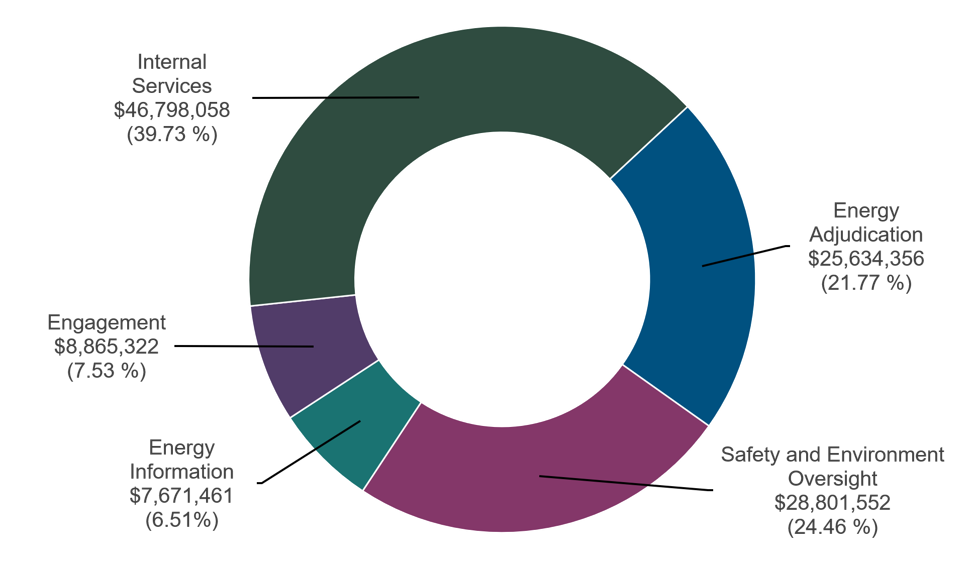
Text version of Figure 1
| Core responsibilities and internal services | 2025-26 actual spending |
|---|---|
| 1. Energy Adjudication | $25,634,356 (21.77%) |
| 2. Safety and Environment Oversight | $28,801,552 (24.46%) |
| 3. Energy Information | $7,671,461 (6.51%) |
| 4. Engagement | $8,865,322 (7.53%) |
| Internal services | $46,798,058 (39.73%) |
Analysis of actual spending by core responsibility
This chart shows 2025-26 spending by core responsibility and internal services
- Energy Adjudication: $25,634,356 (21.77%)
- Safety and Environment Oversight: $28,801,552 (24.46%)
- Energy Information: $7,671,461 (6.51%)
- Engagement: $8,865,322 (7.53%)
- Internal services: $46,798,058 (39.73%)
Budgetary performance summary
Table 1 shows the money the CER spent over the past three years to carry out its core responsibilities and for internal services.
Table 1: Actual three-year spending on core responsibilities and internal services (dollars)
Core responsibilities and internal services |
2025-26 Main Estimates |
2025-26 total authorities available for use |
Actual spending over three years (authorities used) |
|---|---|---|---|
Energy Adjudication |
27,148,413 |
28,339,900 |
|
Safety and Environment Oversight |
30,012,096 |
30,973,305 |
|
Energy Information |
7,179,750 |
9,653,903 |
|
Engagement |
11,628,160 |
11,771,189 |
|
Subtotal |
75,968,419 |
80,738,297 |
|
Internal services |
41,003,427 |
47,770,155 |
|
Total |
116,971,846 |
128,508,452 |
|
Analysis of the past three years of spending
Variance between 2023-24 actual spending and 2024-25 actual spending
The 2024-25 actual spending is $17.29 million higher than the 2023-24 actual spending, and the variance is primarily due to:
- an increase of $7.05 million primarily related to Collective Agreement renewal and other compensation adjustments including changes to terms and conditions of service or employment in the federal public administration.
- an increase of $5.61 million mainly related to changes to support evolving organizational priorities and requirements.
- an increase of $4.27 million related to Grants and Contributions.
- an increase of $1.80 million related to 2024-25 employee benefit plan costs.
- an increase of $1.49 million related to Budget 2024 funding for Indigenous Advisory and Monitoring Committees.
- a decrease of $2.93 million related to Budget 2022 funding for regulatory renewal activities as well as funding to implement the Impact Assessment Act.
Variance between 2024-25 actual spending and 2025-26 actual spending
The 2025-26 actual spending is $13.19 million lower than the 2024-25 actual spending, and the variance is primarily due to:
- a decrease of $8.48 million primarily related to Collective Agreement renewal and other compensation adjustments including changes to terms and conditions of service or employment in the federal public administration;
- a decrease of $5.81 million related to Grants and Contributions;
- a decrease of $0.60 million related to employee benefit plan costs;
- an increase of $1.20 million related to funding for innovative data and information management; and
- an increase of $0.50 million related to funding for regulatory renewal activities.
Variance between 2025-26 actual spending and 2025-26 planned spending
The 2025-26 actual spending is $0.80 million higher than the 2025-26 planned spending, and the variance is primarily due to:
- an increase of $8.17 million related to funding for net-zero energy modeling, innovative data, and information management; as well as regulatory experimentation projects;
- an increase of $0.48 million related to employee benefit plan costs;
- a decrease of $5.16 million related to Grants and Contributions;
- a decrease of $3.86 million mainly related to changes to support evolving organizational priorities and requirements; and
- a decrease of $0.43 million related to funding for Indigenous Advisory and Monitoring Committees.
Variance between 2025-26 actual spending and 2025-26 total authorities available
The 2025-26 actual spending is $10.74 million lower than the 2025-26 total authorities available, and the variance is primarily due to:
- a decrease of $5.16 million related to Grants and Contributions;
- a decrease of $3.66 million related to Operating Budget Carry Forward;
- a decrease of $3.36 million primarily related to eligible paylist as well as other compensation adjustments including changes to terms and conditions of service or employment in the federal public administration;
- an increase of $1.17 million related to employee benefit plan costs; and
- an increase of $0.27 million related to funding for net-zero energy modeling and innovative data and information management.
The Finances section of the Infographic for the CER on GC Infobase provides more financial information from previous years.
Planned spending for next three years
Table 2 shows the CER’s planned spending for each of the next three years on its core responsibilities and on internal services.
Table 2: Planned three-year spending on core responsibilities and internal services (dollars)
Core responsibilities and internal services |
2026-27 planned spending |
2027-28 planned spending |
2028-29 planned spending |
|---|---|---|---|
Energy Adjudication |
29,562,960 |
26,808,652 |
19,670,325 |
Safety and Environment Oversight |
30,651,627 |
29,456,903 |
24,964,926 |
Energy Information |
5,285,390 |
5,195,994 |
5,163,215 |
Engagement |
10,999,449 |
9,669,987 |
5,214,965 |
Subtotal |
76,499,426 |
71,131,536 |
55,013,431 |
Internal services |
42,873,332 |
42,214,569 |
39,546,531 |
Total |
119,372,758 |
113,346,105 |
94,559,962 |
Analysis of the next three years of spending
Variance between 2026-27 planned spending and 2027-28 planned spending
The 2027-28 planned spending is $6.03 million lower than the 2026-27 planned spending primarily related to:
- a decrease of $4.20 million related to Grants and Contributions;
- a decrease of $1.57 million primarily related to Collective Agreement renewal and other compensation adjustments including changes to terms and conditions of service or employment in the federal public administration; and
- a decrease of $0.26 million related to employee benefits plan costs.
Variance between 2027-28 planned spending and 2028-29 planned spending
The 2028-29 planned spending is $18.79 million lower than the 2027-28 planned spending primarily related to:
- a decrease of $11.80 million related to Budget 2022 funding for regulatory renewal activities, as well as funding to implement the Impact Assessment Act;
- a decrease of $5.34 million related to Grants and Contributions; and
- a decrease of $1.65 million mainly related to employee benefits plan costs.
The Finances section of the Infographic for the CER on GC Infobase provides more financial information from previous years.
Funding
This section provides an overview of the department's voted and statutory funding for its core responsibilities and for internal services.
Figure 2 summarizes the department's approved voted and statutory funding from 2023-24 to 2028-29.
Figure 2: Approved funding (statutory and voted) over a six-year period
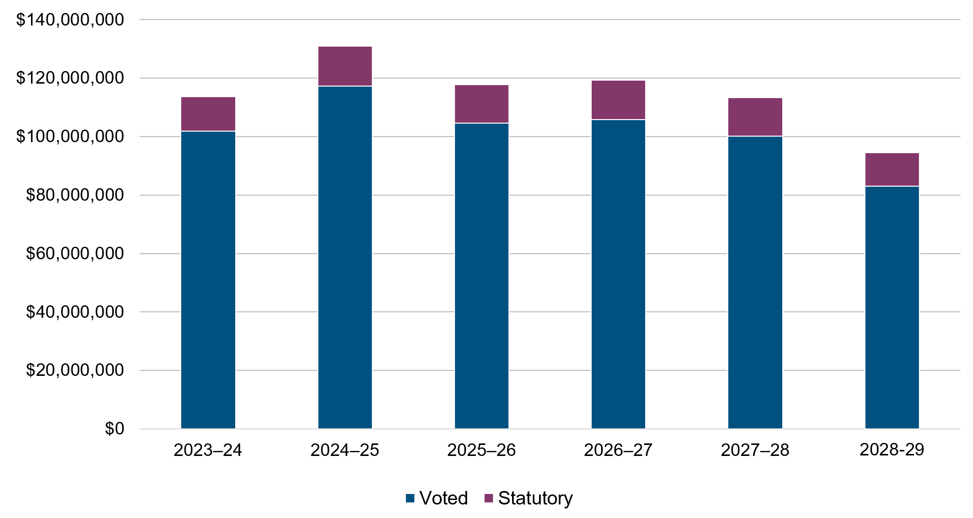
Text version of Figure 2
| Fiscal year | Statutory | Voted | Total |
|---|---|---|---|
| 2023-24 | $11,860,098 | $101,808,167 | $113,668,265 |
| 2024-25 | $13,652,012 | $117,310,821 | $130,962,833 |
| 2025-26 | $13,056,329 | $104,714,420 | $117,770,749 |
| 2026-27 | $13,472,171 | $105,900,587 | $119,372,758 |
| 2027-28 | $13,214,842 | $100,131,263 | $113,346,105 |
| 2028-29 | $11,462,222 | $83,097,740 | $94,559,962 |
Analysis of statutory and voted funding over a six-year period
This bar chart shows the CER’s six-year spending trend. It includes actual spending for the fiscal years 2023-24 through 2025-26 and planned spending for the years 2026-27 to 2028-29. Amounts are depicted by Voted and Statutory amounts. An explanation of spending variances is provided below Table 1: Actual three-year spending on core responsibilities and internal services and Table 2: Planned three-year spending on core responsibilities and internal services.
The CER is funded through Parliamentary appropriations. The Government of Canada currently recovers a large majority of the appropriation from the industry the CER regulates. All collections from cost recovery invoices are deposited to the account of the Receiver General for Canada and credited to the Consolidated Revenue Fund.
Pipeline and power line companies that hold authorizations under the CER Act are subject to cost recovery. Applications before the CER for new facilities are not subject to cost recovery until the facility is placed into service, unless the company does not have any prior facilities regulated by the CER in which case a one-time levy is assessed following the authorization of construction.
Cost recovery is carried out on a calendar year basis.
Consult the Public Accounts of Canada for further information on the CER’s departmental voted and statutory expenditures.
Financial statement highlights
This section presents the CER’s Financial Statements (audited) for the year ended March 31, 2026.
Table 3 summarizes the expenses and revenues for 2025-26, which net to the cost of operations before government funding and transfers.
Table 3: Condensed Statement of Operations (audited) for the year ended March 31, 2026 (dollars)
| Financial information | 2025-26 actual results | 2025-26 planned results | Difference (actual results minus planned) |
|---|---|---|---|
| Total expenses | 131,964,966 | 133,462,935 | (1,497,969) |
| Total revenues | - | - | - |
| Net cost of operations before government funding and transfers | 131,964,966 | 133,462,935 | (1,497,969) |
Analysis of expenses and revenues for 2025-26
The actual net cost of operations before government funding and transfers in 2025-26 was $1.50 million lower than the planned results for the same fiscal year. The net decrease is primarily due to:
- a decrease of $6.57 million related to Grants and Contributions;
- a decrease of $3.13 million mainly related to Operating Budget Carry forward changes to support evolving organizational priorities and requirements;
- a decrease of $1.05 million mainly related to prepaid expenses and capital assets expenses;
- a decrease of $0.43 million related to funding for Indigenous Advisory and Monitoring Committees;
- an increase of $8.17 million related to funding for net-zero energy modeling, innovative data and information management; as well as regulatory experimentation projects;
- an increase of $1.03 million related to funding for regulatory renewal activities as well as funding to implement the Impact Assessment Act; and
- an increase of $0.48 million related to employee benefit plan costs.
The 2025-26 planned results information is provided in the CER’s Future-Oriented Statement of Operations and Notes 2025-26.
Table 4 summarizes actual expenses and revenues and shows the net cost of operations before government funding and transfers.
Table 4: Condensed Statement of Operations (audited) for 2024-25 and 2025-26 (dollars)
| Financial information | 2025-26 actual results | 2024-25 actual results | Difference (2025-26 minus 2024-25) |
|---|---|---|---|
| Total expenses | 131,964,966 | 137,743,243 | (5,778,277) |
| Total revenues | - | - | - |
| Net cost of operations before government funding and transfers | 131,964,966 | 137,743,243 | (5,778,277) |
Analysis of differences in expenses and revenues between 2024-25 and 2025-26
The actual net cost of operations before government funding and transfers in 2025-26 was $5.78 million lower than the actual results for the previous fiscal year, primarily due to:
- a decrease of $7.08 million related to Grants and Contributions;
- an increase of $0.75 million mainly related to employee benefit plan costs; and
- an increase of $0.55 million mainly related to prepaid expenses and capital assets expenses.
Table 5 provides a brief snapshot of the amounts the department owes or must spend (liabilities) and its available resources (assets), which helps to indicate its ability to carry out programs and services.
Table 5: Condensed Statement of Financial Position (audited) as at March 31, 2026 (dollars)
| Financial information | Actual fiscal year (2025-26) | Previous fiscal year (2024-25) | Difference (2025-26 minus 2024-25) |
|---|---|---|---|
| Total net liabilities | 26,073,160 | 33,980,654 | (7,907,494) |
| Total net financial assets | 12,517,568 | 20,451,316 | (7,933,748) |
| Departmental net debt | 13,555,592 | 13,529,338 | 26,254 |
| Total non-financial assets | 10,995,466 | 11,357,916 | (362,450) |
| Departmental net financial position | (2,560,126) | (2,171,422) | (388,704) |
Analysis of department’s liabilities and assets since last fiscal year
Departmental net debt increased by $0.03 million, in comparison to 2024-25. The increase is mainly attributed to increased employee future benefits liabilities.
Departmental net financial position decreased by $0.39 million, in comparison to 2024-25. The decrease is mainly due to decreased capital assets and prepaid expenses, and increased employee future benefits liabilities.
Human resources
This section presents an overview of the department’s actual and planned human resources from 2023-24 to 2028-29.
Table 6 shows a summary in full-time equivalents of human resources for the CER’s core responsibilities and for its internal services for the previous three fiscal years.
Table 6: Actual human resources for core responsibilities and internal services for the last three years
| Core responsibilities and internal services | 2023-24 actual full-time equivalents | 2024-25 actual full-time equivalents | 2025-26 actual full-time equivalents |
|---|---|---|---|
| Energy Adjudication | 120.1 | 117.6 | 126.1 |
| Safety and Environment Oversight | 138.6 | 140.3 | 141.2 |
| Engagement | 46.2 | 47.3 | 43.6 |
| Energy Information | 40.6 | 44.5 | 40.2 |
| Subtotal | 345.5 | 349.7 | 351.1 |
| Internal services | 225.4 | 230.5 | 231.9 |
| Total | 570.9 | 580.2 | 583.0 |
Analysis of human resources over the last three years
Variance between 2023-24 actual full-time equivalents and 2024-25 actual full-time equivalents
The increase of 9.3 full-time equivalents from 2023-24 to 2024-25 is primarily due to:
- an increase of 23.0 full-time equivalents due to changes across the organization to meet operational requirements;
- an increase of 9.6 full-time equivalents related to Budget 2024 funding for Indigenous Advisory and Monitoring Committees; and
- a decrease of 23.3 full-time equivalents related to Budget 2022 funding for regulatory renewal activities, as well as funding to implement the Impact Assessment Act.
Variance between 2024-25 actual full-time equivalents and 2025-26 actual full-time equivalents
The increase of 2.8 full-time equivalents from 2024-25 to 2025-26 is primarily related to funding for innovative data and information management.
Table 7 shows the planned full-time equivalents for each of the CER’s core responsibilities and for its internal services for the next three years. Human resources for the current fiscal year are forecast based on year to date.
Table 7: Human resources planning summary for core responsibilities and internal services for the next three years
| Core responsibilities and internal services | 2026-27 planned full-time equivalents | 2027-28 planned full-time equivalents | 2028-29 planned full-time equivalents |
|---|---|---|---|
| Energy Adjudication | 122.7 | 117.7 | 97.8 |
| Safety and Environment Oversight | 144.9 | 142.2 | 128.2 |
| Energy Information | 36.9 | 37.3 | 37.3 |
| Engagement | 41.2 | 33.1 | 22.2 |
| Subtotal | 345.7 | 330.3 | 285.5 |
| Internal services | 213.7 | 205.1 | 193.9 |
| Total | 559.4 | 535.4 | 479.4 |
Analysis of human resources for the next three years
Variance between 2026-27 planned full-time equivalents and 2027-28 planned full-time equivalents
The decrease of 24.0 full-time equivalents from 2026-27 to 2027-28 is primarily due to:
- a decrease of 10.6 full-time equivalents due to changes across the organization to meet operational requirements; and
- a decrease of 13.4 full-time equivalents related to Budget 2022 funding for regulatory renewal activities, as well as funding to implement the Impact Assessment Act.
Variance between 2027-28 planned full-time equivalents and 2028-29 planned full-time equivalents
The decrease of 56.0 full-time equivalents from 2027-28 to 2028-29 is primarily due to:
- a decrease of 50.9 full-time equivalents related to the loss of funding from Budget 2022 for regulatory renewal activities, as well as to implement the Impact Assessment Act; and
- a decrease of 5.1 full-time equivalents due to changes across the organization to meet operational requirements.
Supplementary information tables
The following supplementary information tables are available on the CER’s website:
Federal tax expenditures
The tax system can be used to achieve public policy objectives through the application of special measures such as low tax rates, exemptions, deductions, deferrals and credits. The Department of Finance Canada publishes cost estimates and projections for these measures each year in the Report on Federal Tax Expenditures. This report also provides detailed background information on tax expenditures, including descriptions, objectives, historical information and references to related federal spending programs as well as evaluations and GBA Plus of tax expenditures.
Corporate information
Departmental profile
Appropriate minister:
The Honourable Tim Hodgson, P.C., M.P.
Institutional head:
Tracy Sletto
Ministerial portfolio:
Energy and Natural Resources
Enabling instrument:
Year of incorporation / commencement:
2019
Other:
The CER Act came into force on 28 August 2019.
Departmental contact information
Mailing address: Headquarters Calgary
210-517 10 Ave SW Calgary AB T2R 0A8
Telephone: 403-292-4800 or 1-800-899-1265
Fax: (403) 292-5503 or 1-877-288-8803
Email: info@cer-rec.gc.ca
Mailing address: Montreal
804-1130 rue Sherbrooke O Montréal QC H3A 2M8
Telephone: (514) 283-2763
Email: infomontreal@cer-rec.gc.ca
Mailing address: Vancouver
219-800 Burrard St Vancouver BC V6Z 0B9
Telephone: (604) 666-3975
Email: infovancouver@cer-rec.gc.ca
Mailing address: Yellowknife
P.O. Box 2213
115-5101 50 Ave Yellowknife NT X1A 2P7
Telephone: (867) 766-8408
Email: infonorth@cer-rec.gc.ca
Website: www.cer-rec.gc.ca
X: @CER_REC
LinkedIn: www.linkedin.com/company/cer-rec
YouTube: www.youtube.com/c/CanadaEnergyRegulator
Facebook: www.facebook.com/CER.REC/
Definitions
List of terms
- appropriation (crédit)
- Any authority of Parliament to pay money out of the Consolidated Revenue Fund.
- budgetary expenditures (dépenses budgétaires)
- Operating and capital expenditures; transfer payments to other levels of government, departments or individuals; and payments to Crown corporations.
- core responsibility (responsabilité essentielle)
- An enduring function or role of a department. The departmental results listed for a core responsibility reflect the outcomes that the department seeks to influence or achieve.
- Departmental Plan (plan ministériel)
- A report that outlines the anticipated activities and expected performance of an appropriated department over a 3-year period. Departmental Plans are usually tabled in Parliament in spring.
- departmental priority (priorité)
- A plan, project or activity that a department focuses and reports on during a specific planning period. Priorities represent the most important things to be done or those to be addressed first to help achieve the desired departmental results.
- departmental result (résultat ministériel)
- A high-level outcome related to the core responsibilities of a department.
- departmental result indicator (indicateur de résultat ministériel)
- A quantitative or qualitative measure that assesses progress toward a departmental result.
- departmental results framework (cadre ministériel des résultats)
- A framework that connects the department’s core responsibilities to its departmental results and departmental result indicators.
- Departmental Results Report (rapport sur les résultats ministériels)
- A report outlining a department’s accomplishments against the plans, priorities and expected results set out in the corresponding Departmental Plan.
- full-time equivalent (équivalent temps plein)
- Measures the person years in a departmental budget. An employee's scheduled hours per week divided by the employer's hours for a full-time workweek calculates a full-time equivalent. For example, an employee who works 20 hours in a 40-hour standard workweek represents a 0.5 full-time equivalent.
- Gender-based Analysis Plus (GBA Plus)(analyse comparative entre les sexes plus [ACS Plus])
- An analytical tool that helps to understand the ways diverse individuals experience policies, programs and other initiatives. Applying GBA Plus to policies, programs and other initiatives helps to identify the different needs of the people affected, the ways to be more responsive and inclusive, and the methods to anticipate and mitigate potential barriers to accessing or benefitting from the initiative. GBA Plus goes beyond biological (sex) and socio-cultural (gender) differences to consider other factors, such as age, disability, education, ethnicity, economic status, geography (including rurality), language, race, religion, and sexual orientation.
- government priorities (priorités pangouvernementales)
- For the purpose of the 2024–25 Departmental Results Report, government priorities are the high-level themes outlining the government’s agenda as announced in the 2021 Speech from the Throne.
- horizontal initiative (initiative horizontale)
- A program, project or other initiative where two or more federal departments receive funding to work collaboratively on a shared outcome usually linked to a government priority, and where the ministers involved agree to designate it as horizontal. Specific reporting requirements apply, including that the lead department must report on combined expenditures and results.
- Indigenous business (enterprise autochtones)
- For the purposes of a Departmental Result Report, this includes any entity that meets the Indigenous Services Canada’s criteria of being owned and operated by Elders, band and tribal councils, registered in the Indigenous Business Directory or registered on a modern treaty beneficiary business list.
- non‑budgetary expenditures (dépenses non budgétaires)
- Net outlays and receipts related to loans, investments and advances, which change the composition of the financial assets of the Government of Canada.
- performance (rendement)
- What a department did with its resources to achieve its results, how well those results compare to what the department intended to achieve, and how well lessons learned have been identified.
- performance indicator (indicateur de rendement)
- A qualitative or quantitative measure that assesses progress toward a departmental-level or program-level result, or the expected outputs or outcomes of a program, policy or initiative.
- plan (plan)
- The articulation of strategic choices, which provides information on how a department intends to achieve its priorities and associated results. Generally, a plan will explain the logic behind the strategies chosen and tend to focus on actions that lead to the expected result.
- planned spending (dépenses prévues)
- For Departmental Plans and Departmental Results Reports, planned spending refers to the amounts presented in Main Estimates. Departments must determine their planned spending and be able to defend the financial numbers presented in their Departmental Plans and Departmental Results Reports.
- program (programme)
- An Individual, group, or combination of services and activities managed together within a department and focused on a specific set of outputs, outcomes or service levels.
- program inventory (répertoire des programmes)
- A listing that identifies all the department’s programs and the resources that contribute to delivering on the department’s core responsibilities and achieving its results.
- result (résultat)
- An outcome or output related to the activities of a department, policy, program or initiative.
- statutory expenditures (dépenses législatives)
- Spending approved through legislation passed in Parliament, other than appropriation acts. The legislation sets out the purpose and the terms and conditions of the expenditures.
- target (cible)
- A quantitative or qualitative, measurable goal that a department, program or initiative plans to achieve within a specified time period.
- voted expenditures (dépenses votées)
- Spending approved annually through an appropriation act passed in Parliament. The vote also outlines the conditions that govern the spending.
- Date modified: